You published your website, wrote the pages, and waited. But when you search for your own services, you’re nowhere on page one. It’s frustrating, and it’s more common than you’d think.
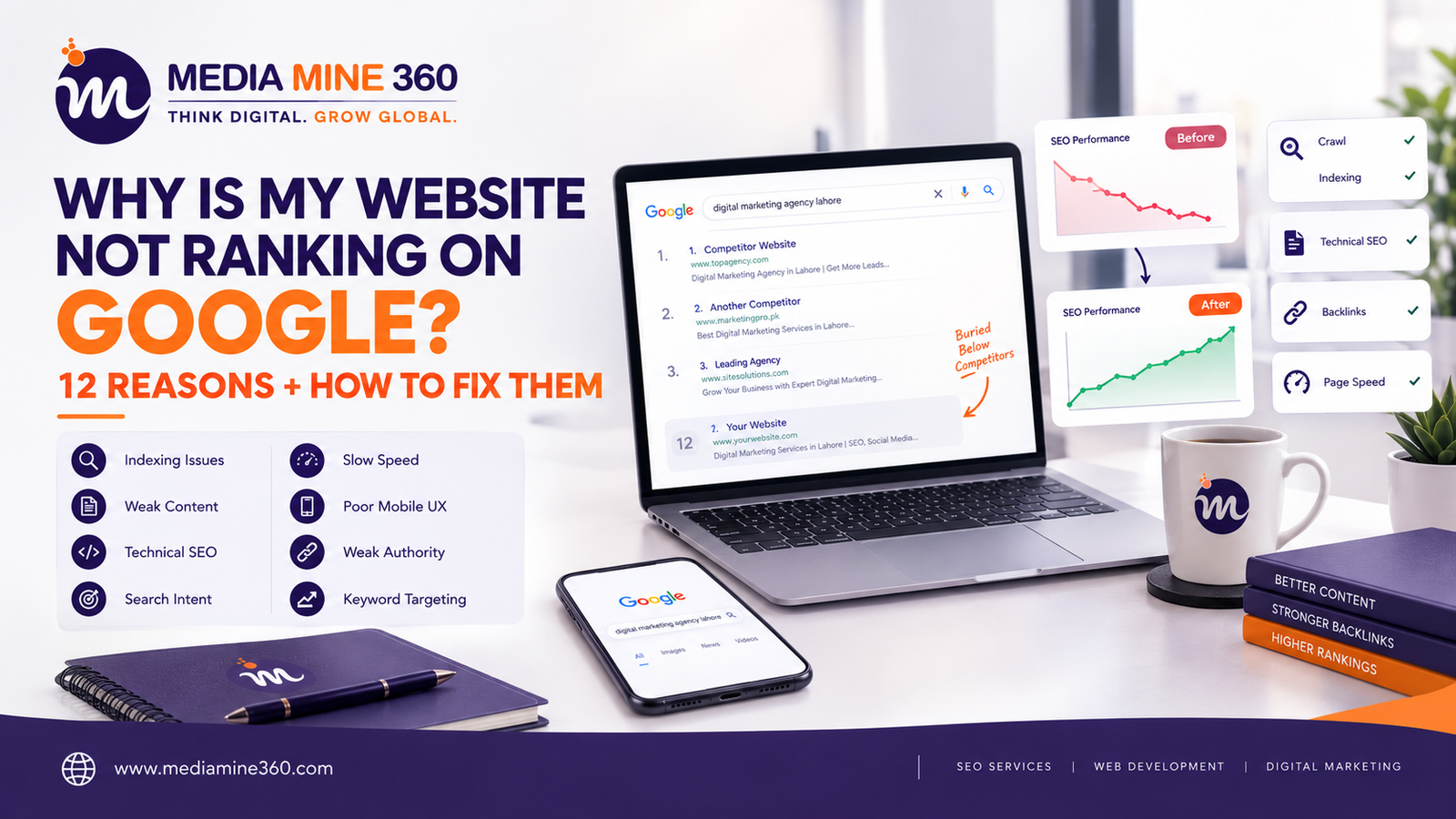
The good news is that a website that isn’t ranking usually has identifiable problems. Below are the 12 most common reasons, with a practical fix for each, so you can diagnose your own site step by step.
1. Your Website Isn’t Indexed by Google
If Google hasn’t indexed your pages, they can’t rank. This happens with new sites, accidental “noindex” tags, or blocked crawling.
How to fix it:
- Search
site:yourdomain.comon Google to see which pages are indexed. - Check Google Search Console’s Pages report for “Excluded” or “Not indexed” warnings.
- Make sure your robots.txt file and meta robots tags aren’t blocking important pages.
- Submit an XML sitemap in Search Console.
2. You’re Targeting the Wrong Keywords
Many businesses chase broad, highly competitive keywords like “web design” or “digital marketing” and wonder why they never appear. Others target keywords that nobody actually searches.
How to fix it:
- Go after specific, intent-driven keywords (for example, “SEO services for small businesses” instead of just “SEO”).
- Match the search intent. If Google shows blog guides for a query, a sales page won’t rank.
- Assign one primary keyword to each page, and support it with related terms.
3. Your Content Is Thin or Low Quality
Short, generic pages that repeat what everyone else has already said give Google no reason to rank you higher. Content written only for search engines rarely performs well.
How to fix it:
- Answer the searcher’s question completely, with original examples, data, and expertise.
- Update outdated pages instead of leaving them untouched for years.
- Add helpful elements like FAQs, images, comparisons, and step-by-step instructions.
- Show real experience and credibility through author bios, case studies, and reviews.
4. Your Website Is Too Slow
Slow loading frustrates visitors and hurts your performance in search. If your pages take more than a few seconds to load, people leave before they see your content.
How to fix it:
- Compress images and use modern formats like WebP.
- Remove unnecessary plugins, scripts, and bulky themes.
- Use quality hosting, caching, and a CDN.
- Test regularly with Google PageSpeed Insights and review your Core Web Vitals.
5. Your Site Isn’t Mobile-Friendly
Google primarily uses the mobile version of your site for ranking. If buttons are tiny, text is hard to read, or layouts break on phones, your rankings can suffer.
How to fix it:
- Use a responsive design that adapts to every screen size.
- Make sure buttons and links are easy to tap.
- Avoid intrusive pop-ups that cover content on mobile.
- Test on real devices, not just desktop browser resizing.
6. Technical SEO Problems Are Holding You Back
Behind the scenes, technical errors can quietly block your progress: broken links, redirect chains, duplicate pages, missing HTTPS, poor site structure, or crawl errors.
How to fix it:
- Run a full technical audit using tools like Google Search Console, Screaming Frog, or Ahrefs.
- Fix broken links (404s) and unnecessary redirects.
- Use a clean URL structure, proper heading hierarchy, and canonical tags.
- Make sure your site is secured with HTTPS.
Not sure what’s wrong with your site?
Finding technical and content issues takes the right tools and experience. Get a clear picture of what’s holding your rankings back with a professional SEO audit from Media Mine →
7. You Have Weak or Spammy Backlinks
Backlinks remain one of Google’s strongest trust signals. If few reputable sites link to you, or if your links come from low-quality directories and spammy sources, your authority stays low.
How to fix it:
- Earn links through useful content, guest posts, digital PR, and partnerships.
- Get listed in relevant, high-quality industry directories.
- Disavow or remove clearly toxic links if they’re harming you.
- Focus on quality over quantity. A few strong links beat hundreds of weak ones.
8. Poor User Experience Is Driving Visitors Away
If visitors land on your page and leave immediately because the design is confusing, the message is unclear, or the page is cluttered, it signals that your page isn’t satisfying their search.
How to fix it:
- Make navigation simple and intuitive.
- Put the key answer or value proposition near the top of the page.
- Break content into short paragraphs, headings, and bullet points.
- Add clear calls to action so visitors know the next step.
9. You’re Ignoring Local SEO
If you serve customers in a specific city or area, ranking nationally isn’t the goal. Being visible in local searches and the map pack is. Businesses that skip local optimization lose high-intent customers to nearby competitors.
How to fix it:
- Fully optimize your Google Business Profile with accurate details, photos, and categories.
- Keep your name, address, and phone number consistent across all listings.
- Collect and respond to customer reviews.
- Create location-specific content. Here are the best local SEO strategies for businesses in Lahore if you operate in that market.
10. You Haven’t Adapted to AI-Driven Search
Search is changing. Google’s AI-generated answers and tools like ChatGPT now influence how people discover businesses. If your content isn’t clear, structured, and authoritative, AI systems are less likely to reference or recommend you.
How to fix it:
- Write clear, direct answers to common questions in your content.
- Use structured headings, FAQs, and schema markup.
- Build brand authority and consistent mentions across the web.
- Understand how traditional and AI-driven optimization differ by reading GEO vs SEO in 2026.
11. A Google Update or Penalty May Have Hit You
If your rankings dropped suddenly, a core algorithm update or a manual action may be the cause. Sites with thin content, spammy links, or deceptive practices are most vulnerable.
How to fix it:
- Check Google Search Console for manual action notices.
- Compare your traffic drop dates with known Google update timelines.
- Improve content quality, remove spammy practices, and clean up your link profile.
- Be patient. Recovery after an update usually takes time and consistent improvements.
12. You Expect Results Too Quickly
SEO isn’t instant. A new website or a freshly optimized page can take months to show meaningful movement, especially in competitive industries. Many business owners give up or change strategy too early.
How to fix it:
- Set realistic expectations and track progress with the right metrics: impressions, rankings, and qualified leads.
- Stay consistent with content, technical improvements, and link building.
- Learn what to expect by reading how long SEO takes to show results.
Case Study: How The Rental Specialists Improved Their Online Visibility
Everything above can sound theoretical, so here’s how it looks in practice.
The client: The Rental Specialists is an Auckland-based property management company offering residential property management, casual letting, tenant screening, rent collection, and compliance support for landlords.
The Challenge
Property management is a highly competitive local market. Landlords searching for terms like “property management Auckland” compare several providers before making contact. The Rental Specialists had a strong service offering, but their website needed stronger visibility for these searches to compete and generate consistent landlord inquiries.
What We Did
- Technical SEO audit: Checked the site for indexing, speed, mobile usability, and crawl issues, then fixed what was holding performance back.
- Keyword and content strategy: Targeted landlord-focused, location-specific keywords with dedicated service pages.
- Local SEO: Strengthened local signals, including Google Business Profile optimization and consistent business information.
- On-page optimization: Improved titles, meta descriptions, headings, and internal linking.
- Conversion improvements: Added clearer CTAs and enquiry paths so visitors could easily request a rental appraisal.
The Results
Over the following months, The Rental Specialists saw stronger visibility for landlord-focused searches in Auckland, more organic visitors reaching their service pages, and a clearer path from search to rental appraisal enquiry. Their site now has a solid technical foundation, location-specific content, and conversion-focused pages that continue to build results over time.
Key Takeaway
The rental specialists didn’t need a complete rebuild. They needed the fundamentals fixed in the right order: technical health, relevant content, local visibility, and a clear path to inquiry. If your website isn’t ranking, the same step-by-step approach can work for your business. See how our SEO services can help.
Quick Checklist: Why Isn’t My Website Ranking?
- Are my important pages indexed in Google?
- Am I targeting realistic keywords with clear search intent?
- Is my content detailed, original, and helpful?
- Does my site load fast on mobile and desktop?
- Have I fixed technical errors and broken links?
- Do I have quality backlinks from trusted sites?
- Is my Google Business Profile optimized for local searches?
- Is my content ready for AI-driven search?
- Have I given my SEO efforts enough time?
When to Get Professional Help
Some fixes, like updating content or compressing images, you can handle yourself. Others, like technical audits, link building, and competitive analysis, are easier with an experienced team. If your rankings have stalled despite your efforts, it may be time to work with a specialist. Not sure how to choose one? This guide on how to find an SEO company in Lahore that grows your business walks you through what to look for.
Frequently Asked Questions (FAQs)
Why is my website not showing up on Google at all?
The most common reasons are that your site isn’t indexed yet, it’s blocked by a noindex tag or robots.txt file, or it’s too new for Google to have crawled. Check Google Search Console to confirm indexing status and submit your sitemap.
How long does it take for a new website to rank on Google?
Most new websites take around 3 to 6 months to see meaningful ranking improvements, and competitive keywords can take longer. The timeline depends on your industry, content quality, backlinks, and technical setup.
Why did my website’s rankings suddenly drop?
Sudden drops are often caused by Google algorithm updates, technical errors (like accidental noindex tags or site migrations), lost backlinks, or a manual penalty. Review Google Search Console and compare the date of the drop with recent updates.
Does website speed affect Google rankings?
Yes. Page speed and Core Web Vitals are part of Google’s page experience signals, and slow sites also have higher bounce rates, which hurts conversions even if rankings hold.
Do I need backlinks to rank on Google?
For most competitive keywords, yes. Backlinks from relevant, trustworthy websites signal authority. Low-competition or local searches can sometimes rank with fewer links, but quality backlinks make ranking easier and more stable.
Can I fix my website’s SEO myself, or should I hire an agency?
Basic fixes like improving content, adding keywords, and optimizing images can be done in-house. For technical audits, link building, and ongoing strategy, an experienced SEO team usually saves time and delivers faster, more reliable results.
Does SEO still matter with AI search tools like ChatGPT?
Yes. Strong SEO fundamentals, such as quality content, authority, and clear structure, also help AI systems understand and recommend your brand. The two approaches work best together.
Ready to Fix Your Rankings?
Stop guessing why your website isn’t performing. The Media Mine team can audit your site, uncover what’s holding you back, and build a strategy that brings in qualified traffic and leads.