First Things First: What Are We Actually Talking About?
Before we get into the truths, let’s make sure we’re speaking the same language because these terms get thrown around loosely and that causes real confusion.
SEO (Search Engine Optimization)
You know this one. It’s the practice of getting your content to rank in traditional search results, primarily Google, but also Bing and others. The classic toolkit: keywords, backlinks, technical site health, on-page optimization, Core Web Vitals.
GEO (Generative Engine Optimization)
This is the newer discipline and the one most marketers are still catching up on. GEO is about optimizing your content so AI-powered tools cite, quote, or surface it in their generated responses. We’re talking Google AI Overviews, ChatGPT search, Perplexity AI, Microsoft Copilot, and Gemini AI search. Instead of appearing on a ranked list, the goal is to become the source an AI model actually references.
AEO (Answer Engine Optimization)
Think of AEO as the bridge between SEO and GEO. It’s about structuring content to directly answer specific questions, optimizing for featured snippets, voice search, and the kind of crisp, pull-ready answers that AI models love.
So How Do AEO vs GEO vs SEO Actually Relate?
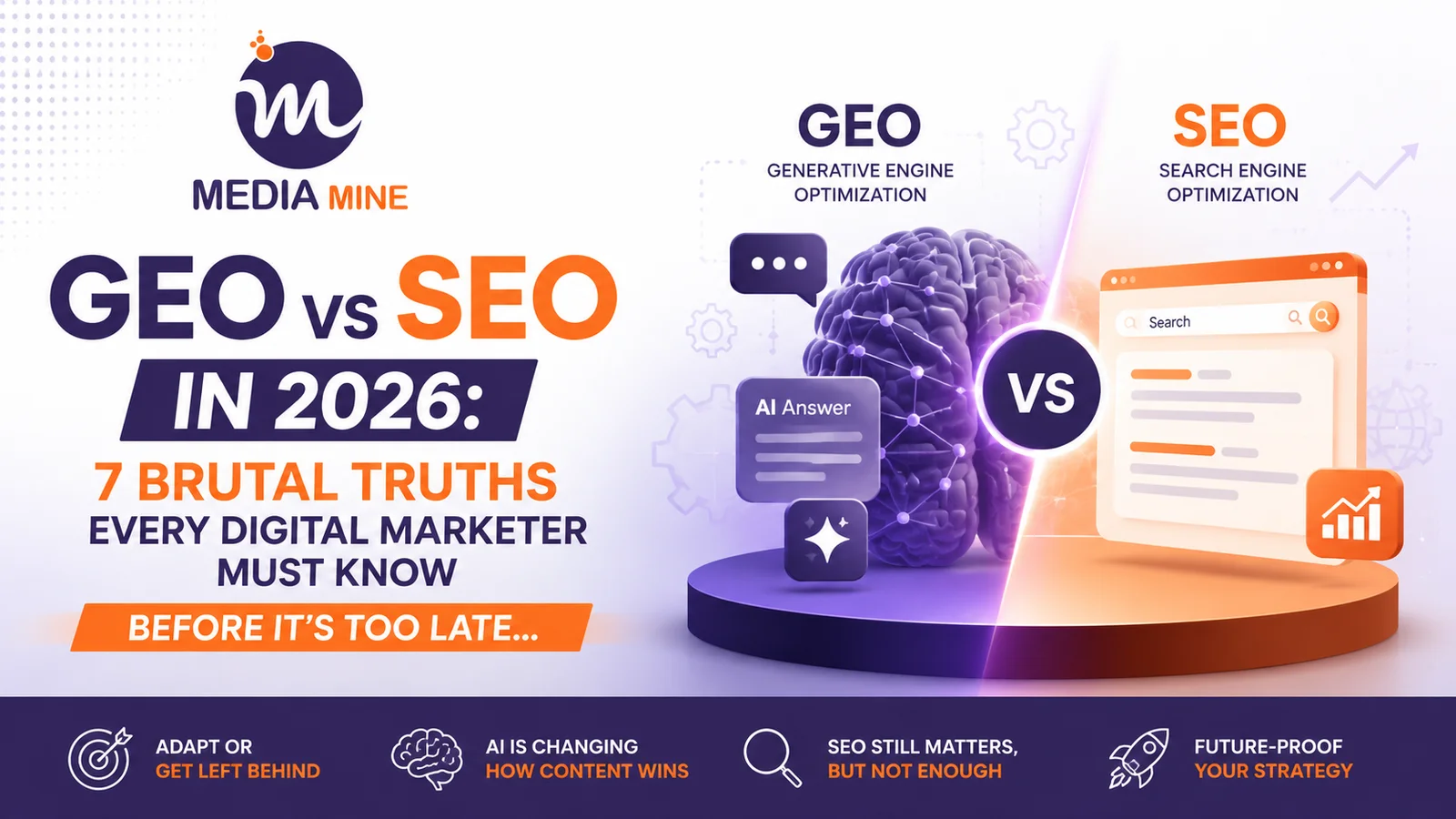
They’re not rivals; they’re layers. SEO builds authority. AEO shapes your content into answerable formats. GEO pushes that content into AI citation territory. Running all three together isn’t optional anymore; it’s just what good content strategy looks like in 2026.
7 Brutal Truths About GEO vs SEO in 2026
Truth #1: AI Search Traffic Is Already Here and It’s Bigger Than Most People Realize
A lot of marketers are still treating AI search like something on the horizon. It isn’t.
Google AI Overviews now show up for nearly half of all US search queries. ChatGPT has crossed 200 million weekly active users, and a huge portion of them use it as their go-to research tool not just for casual curiosity but for real purchasing decisions. Perplexity AI is handling hundreds of millions of queries monthly. Microsoft Copilot is woven into Windows, Edge, and the entire Microsoft 365 ecosystem, meaning it’s sitting on the desktops of millions of professionals every single day.
That’s not a future projection. That’s where things stand right now.
So How Do You Actually Get Traffic From AI Search?
When AI models generate answers, they pull from sources, and those sources get cited. That citation is a link. That link drives traffic. It’s called LLM traffic, and it tends to be high-quality because visitors already have context about your content before they click. They’re not browsing. They’re arriving with intent.
Truth #2: Traditional SEO Isn’t Dead It’s the entry ticket.
Every few months, someone publishes a piece declaring SEO dead. Every time, they’re wrong. And in 2026, they’re still wrong just for slightly different reasons.
Here’s the thing: Google AI Overviews don’t pull answers from random corners of the internet. They pull from indexed, authoritative, well-structured content. If your domain has a weak backlink profile, thin content, or shaky E-E-A-T signals, AI Overviews won’t touch you — no matter how GEO-optimized your writing looks on the surface. Same goes for ChatGPT’s browsing responses and Perplexity AI SEO. Both rely on credible, accessible web sources.
Traditional SEO is no longer the destination. It’s the price of admission.
Why “Traditional SEO vs AI Search” Is the Wrong Frame
Framing this as a competition misses the point entirely. Traditional SEO builds the foundation. GEO is what you construct on top of it. Skip the foundation, and nothing holds.
What has genuinely shifted is which SEO signals carry the most weight:
- Topical authority now beats chasing individual keyword rankings
- Depth and accuracy outperform keyword density every single time
- Structured, citable answers beat keyword-heavy blocks of text
- E-E-A-T—Experience, Expertise, Authoritativeness, Trustworthiness—has become the most important credibility signal across both traditional and AI search environments
Truth #3: Ranking in Google AI Overviews Requires a Different Approach
Getting into Google AI Overviews isn’t the same game as hitting page one. The optimization logic is different, and if you’re applying the same tactics to both, you’re leaving citations on the table.
AI Overviews consistently favor content that:
- Answers the question immediately — within the first 100 words of a section, not buried three paragraphs down
- Uses clean, scannable formatting — headers, bullet points, numbered steps that an AI can extract cleanly
- Demonstrates genuine expertise—named authors, first-hand perspective, cited data
- Covers topics completely—not just the surface question, but the surrounding context
- Loads quickly on mobile — technical SEO still matters, full stop
A Practical Google AI Overviews Optimization Starting Point
- Open every major section with a direct, plain-language answer
- Write H2–H4 headers that mirror how real people phrase questions
- Add FAQ schema to your most important pages
- Build content clusters around your core topics rather than isolated posts
- Earn backlinks from relevant, authoritative sources in your space
Truth #4: Getting Into ChatGPT Answers Is Achievable If You Know What It Looks For
ChatGPT search optimization doesn’t require cracking some secret algorithm. When ChatGPT browses the web, it favors content that reads like it was written by someone who genuinely knows their subject, not content that was assembled to rank.
Specifically, it gravitates toward:
- Real author credentials — a name, a bio, a track record. Generic “Staff Writer” bylines do not cut it
- Tight, precise writing — ChatGPT extracts specific, usable facts. It doesn’t quote long-winded passages
- Original insight or data—if your content just paraphrases what’s already out there, it’s not giving the model anything new to work with
- Technically accessible pages—if the crawler can’t get in, you don’t get cited
How to Appear in ChatGPT Answers: The Plain Version
Publish content that is genuinely useful, clearly expert-led, and technically easy to crawl. That’s really the formula. There’s no hack. But there is a straightforward path if you’re willing to invest in content quality.
Truth #5: Perplexity AI and Microsoft Copilot Are Opportunities Most Marketers Are Ignoring
Everyone is focused on Google. That’s understandable; it’s still the biggest player. But in 2026, two platforms represent serious untapped opportunity that most content teams aren’t touching yet.
Perplexity AI SEO is particularly worth your attention. Perplexity shows its sources prominently users literally see which sites contributed to an answer. Being cited there means brand visibility and direct referral traffic, not just a silent algorithm acknowledgment. Perplexity responds especially well to:
- Data-backed, specific content (vague generalities don’t get cited)
- Clean listicle and how-to formats
- Precise, unambiguous language: no fluff, no filler
Microsoft Copilot SEO runs on Bing’s index underneath. If you’ve been treating Bing as an afterthought and most people have that’s actually a quick win sitting right there. Verify your site in Bing Webmaster Tools, tighten your structured data, and make sure your content answers both informational and commercial queries clearly.
Gemini AI search ranking operates through Google’s own AI layer, so standard AI overview optimization largely applies. Gemini does seem to reward established, verified entities more heavily, which means brand-building and Google Business Profile hygiene carry real weight alongside content quality.
Truth #6: “GEO vs SEO: Which Is Better?” is Honestly the Wrong Question
It’s the most common question in this space right now, and it makes sense why people ask it. But the framing sets you up to make a bad decision.
GEO without SEO is a strategy built on sand. AI models aren’t going to cite low-authority, poorly indexed content just because it’s well-structured. The authority has to already be there.
SEO without GEO awareness in 2026 means you’re optimizing for a channel that’s being compressed by AI overviews eating zero-click queries at a growing rate. You’re doing real work for shrinking returns.
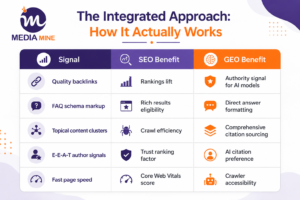
The brands winning AI search traffic in 2026 aren’t picking a side. They’re running both intentionally together.
Truth #7: Generative Engine Optimization Traffic Takes Time and That’s Actually Good News
Here’s the truth that nobody really wants to hear but everyone needs to: GEO is not a shortcut.
You cannot buy your way into ChatGPT citations. You cannot keyword-stuff your way into Google AI Overviews. The AI models surfacing content in 2026 are getting increasingly sophisticated at recognizing genuine expertise versus manufactured authority.
But here’s the flip side of that, and this is actually the encouraging part: the businesses building real, well-structured, expert-led content right now are accumulating a compounding asset. Every properly formatted FAQ, every credible author signal, every original data point is a potential citation opportunity across every AI platform: Google, ChatGPT, Perplexity, Copilot, Gemini, and whatever platforms emerge in the next two years.
The marketers who build this foundation now won’t have to scramble later. The ones who don’t? They’ll be playing catch-up while their competitors are already being cited by every AI tool their customers use.
AEO vs GEO vs SEO: A Simple Framework for 2026
Not sure where to focus your energy? Here’s a clear way to think about it.
Start with SEO if: Your domain authority is under 30, your technical site health has issues, or your backlink profile is thin. You cannot skip this step.
Add AEO when your core content is in solid shape and you want to start capturing featured snippets, voice search traffic, and direct answer placements. Reformat existing content with FAQ schema, question-phrased headers, and clear answer-first paragraphs.
Layer in GEO when you have topical authority established and you’re ready to pursue AI search citations deliberately. Focus on content comprehensiveness, genuine expert authorship, and earning links from respected sources in your niche.
For most businesses in 2026, all three should be running in parallel with GEO receiving more attention and budget each quarter as AI search traffic continues to grow.
Frequently Asked Questions
Does GEO replace SEO in 2026? No, and this is probably the most important thing to understand going into any content strategy conversation this year. GEO extends SEO; it doesn’t replace it. AI models use the same foundational authority signals that Google’s traditional algorithm relies on. If your SEO is weak, your GEO efforts won’t gain traction.
Does SEO still work in 2026? Yes, absolutely, but its role has shifted. Traditional SEO still drives rankings in standard search results, which continue to receive substantial traffic. It also powers AI search visibility indirectly, since AI Overviews and ChatGPT both prefer high-authority, well-indexed sources. Running SEO without GEO awareness just means you’re leaving an increasingly significant channel unaddressed.
How do I increase organic traffic with GEO? Focus on four things: expert-authored content with clear E-E-A-T signals, structured data and FAQ schema markup, comprehensive topic coverage that gives AI models complete answers to work with, and a technically clean site that AI crawlers can actually access and index without friction.
What AI SEO ranking factors matter most right now? Topical authority, factual accuracy, clear author credentials, structured formatting, schema markup, page speed, and citation-worthiness, meaning original data, clear definitions, and direct answers that an AI can extract and attribute. These factors are consistent across Google AI Overviews, ChatGPT, and Perplexity.
Is GEO better than SEO for traffic from ChatGPT and Perplexity specifically? For targeting those platforms directly, yes, GEO-oriented tactics like structured answers, expert authorship, and original insights are more immediately relevant. But they only deliver results on a strong SEO foundation. GEO is the strategy. SEO is the infrastructure you run it on.
Conclusion: The Window to Get Ahead Is Open But Not Forever
The marketers who dominated Google’s early algorithm updates were the ones who understood E-A-T signals before everyone else caught on. The ones who will dominate AI search in 2027 are the ones treating GEO seriously right now before their competitors finish reading articles like this one.
You now have the 7 brutal truths laid out clearly: AI search traffic is already substantial and growing fast; traditional SEO remains your foundation. Google AI Overviews reward structured and direct answers; ChatGPT and Perplexity favor genuine expert sources; Copilot and Gemini are underrated opportunities worth pursuing; GEO and SEO are stronger together than either is alone; and earning AI citations is a long-term brand asset, not a one-time tactic.
The real question isn’t whether this matters. It clearly does. The question is whether you act on it before your competitors do.
Ready to build a content strategy that works across both traditional and AI search? Media Mine 360 helps businesses navigate exactly this integrated SEO and GEO strategy designed to drive measurable traffic in 2026 and beyond. We don’t just talk about what’s changing. We build the systems that keep you visible through it.
👉 See what we can do for your brand or reach out to our team directly because in a landscape moving this fast, waiting is its own kind of risk.