So you just kicked off an SEO campaign — or maybe you’re still deciding whether it’s worth the investment. Either way, there’s one question almost everyone asks eventually: “When am I actually going to see this working?”
It’s a reasonable thing to wonder. SEO isn’t like a paid ad you switch on and watch deliver clicks by dinner time. It’s slower and a bit messier, and honestly, that’s kind of the point — because what it builds tends to stick around long after you’ve stopped paying for it. In this guide, we’ll go through what a realistic SEO timeline actually looks like heading into 2026, what factors speed things up (or drag them out), and where proper SEO Services can genuinely help without resorting to shortcuts you’ll regret in six months.
By the end, you should have a pretty clear picture of what to expect at each stage — and how to set goals that won’t leave you disappointed by month two.
What Is SEO and Why Does Timing Matter?
SEO — search engine optimization — is basically the work of shaping your website so it shows up higher on Google (and other search engines) for the things your customers are actually typing into the search bar. It’s not one thing. It’s your site’s technical bones, the quality of what you’re publishing, how many other trustworthy sites point back to you, all of it working together.
And timing matters because search engines don’t just glance at your site once and make a call. They come back. Again and again. Crawling, re-indexing, quietly deciding over weeks and months whether your domain deserves more trust than it had last time. That slow build is really the whole reason nobody can promise you overnight rankings.
The Short Answer
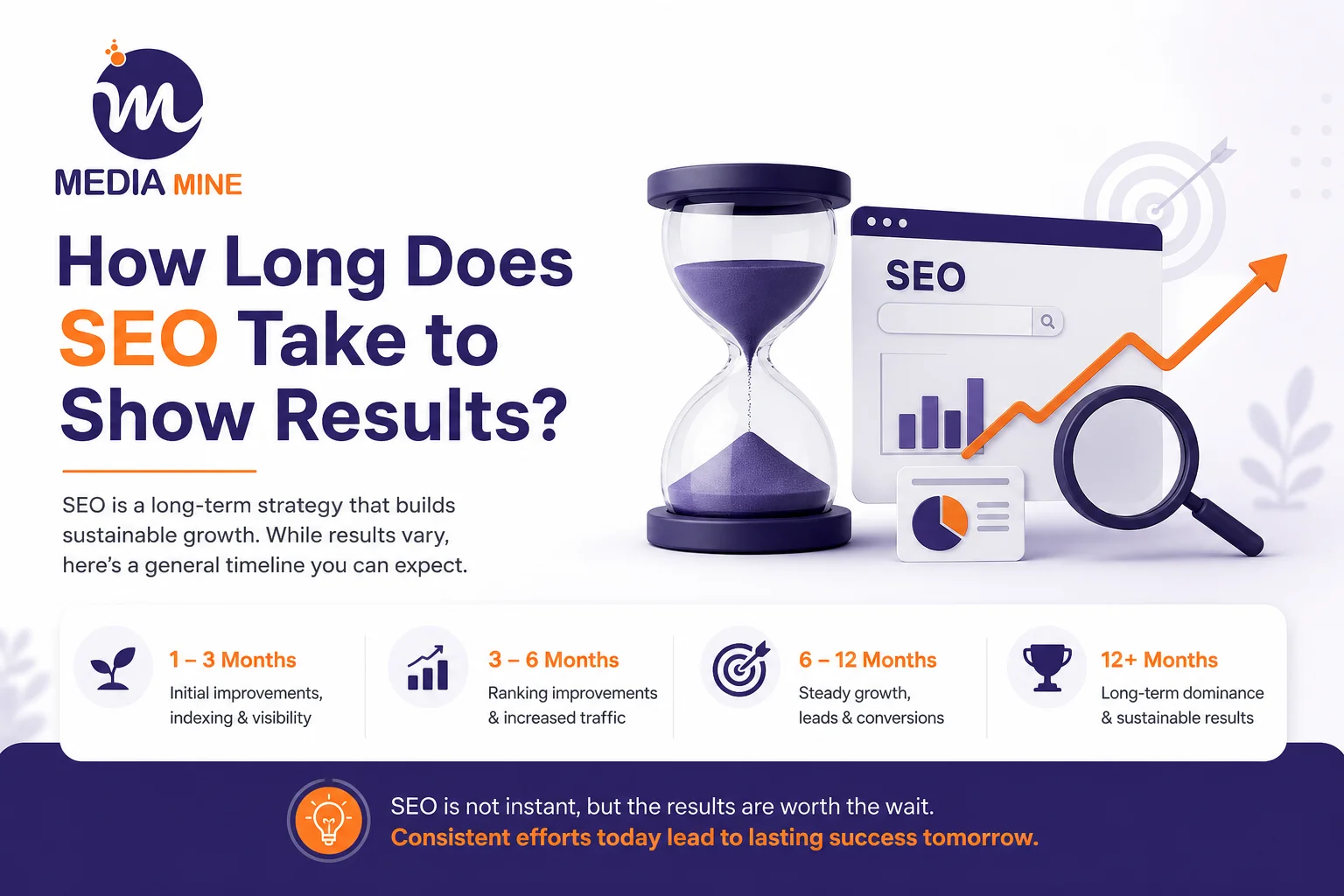
Most websites start seeing genuine movement — better rankings, more traffic — somewhere in the 3 to 6 month range. The results that really compound, the ones that make a noticeable dent, tend to show up between 6 and 12 months. If you’re in a competitive space or working with a fairly new site, give it a bit longer than that.
How Long Does SEO Really Take? A Realistic Timeline
Let’s actually break down what’s happening behind the scenes, stage by stage.
Months 1–3: The Foundation Phase
This part isn’t flashy. A technical audit, cleaning up crawl errors, tightening on-page elements, mapping out what content needs to exist — none of it shows up as a big traffic spike, but skip it and you’ll pay for it later. Most SEO campaigns that fail, fail here, because someone got impatient and rushed past this stage. Try not to expect much movement yet. That’s normal, not a red flag.
Months 4–6: The Momentum Phase
By now search engines have actually had time to process everything you’ve changed. This is usually when you start noticing the small wins — a few keywords creeping onto page two, a modest lift in organic traffic, maybe better click-through rates because your titles and meta descriptions finally make sense.
Beyond Year One
Here’s something worth knowing: SEO compounds. A site that’s been consistently optimized for a year, with content and backlinks built up over time, will almost always beat a brand-new competitor doing the exact same tactics. Search engines just trust the sites that have stuck around and kept showing up.
Factors That Affect How Fast SEO Works
Not every site moves at the same pace, and there’s nothing wrong with that. Here’s what usually decides how quickly (or slowly) things happen.
Website Age and Authority
A domain that’s been active for years, already carrying some backlink history, generally has a head start over one starting from absolute zero.
Competition in Your Industry
Ranking for “coffee shop” and ranking for “coffee shop near me” in a mid-sized city are two very different battles. More businesses fighting for the same keywords usually means a longer, harder climb.
Local vs. National Competition
This is honestly where Local SEO services tend to shine. You’re competing against a smaller, more localized pool instead of the entire country, which often means quicker visibility in map packs and local results compared to going after broad national terms.
Quality of the SEO Services You’re Using
Not all SEO Services are built the same, and it shows fast. Some agencies still rely on shortcuts — keyword stuffing, sketchy link farms — that might spike your numbers briefly before a penalty wipes it all out. A slower, more careful, data-driven approach takes longer to gain traction, sure, but it actually lasts.
Content Quality and Consistency
Publishing one blog post and disappearing for three months isn’t going to move anything. Search engines tend to favor sites that consistently put out genuinely useful content — stuff that actually answers what people are searching for, not content written just to hit a keyword count.
Technical SEO Health
Page speed, mobile-friendliness, HTTPS, a site structure that actually makes sense — all of this affects how well search engines can crawl and understand your pages. Leave technical problems unaddressed long enough, and even great content can quietly stop working as well as it should.
Why Local SEO Services Often Show Faster Results
If your business serves a specific city or region rather than trying to compete nationally, Local SEO services can often get you noticeable results a lot sooner.
Lower Competition, Quicker Wins
Since you’re only competing with businesses in your immediate area — not the whole market — well-optimized local listings and location pages can start gaining traction within a few weeks to a couple of months. That’s considerably faster than most national campaigns.
Google Business Profile Impact
A properly optimized Google Business Profile — right categories, real photos, active reviews, consistent business details everywhere — is genuinely one of the fastest-moving pieces of local SEO. It’s not unusual to see better local pack visibility within just a few weeks of getting this right.
How to Speed Up Your SEO Results (Without Cutting Corners)
There’s no real hack that makes SEO instant — anyone who tells you otherwise is probably setting you up for a penalty. But there are smarter, faster ways to get there.
Prioritize Technical Fixes First
Before spending heavily on content or backlinks, make sure the site itself loads quickly, works properly on mobile, and isn’t riddled with crawl errors. Fix this first, and everything else you do afterward works better.
Focus on Search Intent
Instead of chasing keywords just because they get a lot of searches, build content around what people are actually trying to find. Search engines have gotten noticeably better at rewarding pages that satisfy intent clearly and quickly, rather than pages that just repeat a phrase a bunch of times.
Build Quality Backlinks Steadily
A handful of relevant, high-quality backlinks earned gradually will do more for your rankings than a huge batch of low-quality links acquired all at once — and it won’t put you at risk of a penalty somewhere down the line.
Common SEO Mistakes That Delay Results
Even businesses with good intentions end up slowing their own progress. A few of the usual culprits:
- Expecting instant results, then giving up right when things were about to start working
- Making constant, drastic site changes that confuse search engines about what’s going on
- Ignoring mobile speed and performance
- Publishing thin or duplicate content just to have “something” up
- Choosing SEO Services based mostly on price rather than actual strategy
Fix just these five things, and you could realistically shave weeks — sometimes months — off your timeline.
Frequently Asked Questions
How long does SEO take to show results for a new website?
Usually somewhere between 6 and 12 months, simply because a brand-new domain has no history for search engines to trust yet — that trust has to be earned over time.
Can SEO show results in 30 days?
Some early signals — faster load times, resolved technical errors, small keyword shifts — can show up within a month. But real traffic and ranking growth almost always takes longer than that.
Is Local SEO faster than national SEO?
Generally, yes. Local SEO services tend to show visible progress in local search and map results sooner, mostly because there’s simply less competition to work through.
Does paying for SEO Services guarantee faster results?
No legitimate agency can promise instant rankings — and you should be wary of any that do. What solid SEO Services actually offer is a shorter path there, by avoiding expensive mistakes and applying strategies that are backed by real data from day one.
Why did my SEO results drop after initially improving?
It happens more often than people expect — algorithm updates, new competitors entering the space, or a lull in content output can all cause it. Some ups and downs are normal. What matters is staying consistent instead of scrapping the whole strategy at the first dip.
Final Thoughts and Next Steps
SEO isn’t a quick fix, and honestly, anyone promising you otherwise probably isn’t being straight with you. But with realistic expectations and steady effort, most businesses start seeing genuine traction within 3 to 6 months, with the bigger, compounding growth kicking in around the one-year mark.
If you’re ready to stop guessing and actually see measurable progress, Media Mine 360 can help you get there. Our team blends creative strategy with data-driven SEO Services — including tailored Local SEO services — to help your business grow online, all built around a client-first approach that puts your goals front and center.
Reach out to Media Mine 360 today via WhatsApp, email at info@mediamine360.com, or call +44 7424 505173, and let’s put together a personalized SEO roadmap for your business.