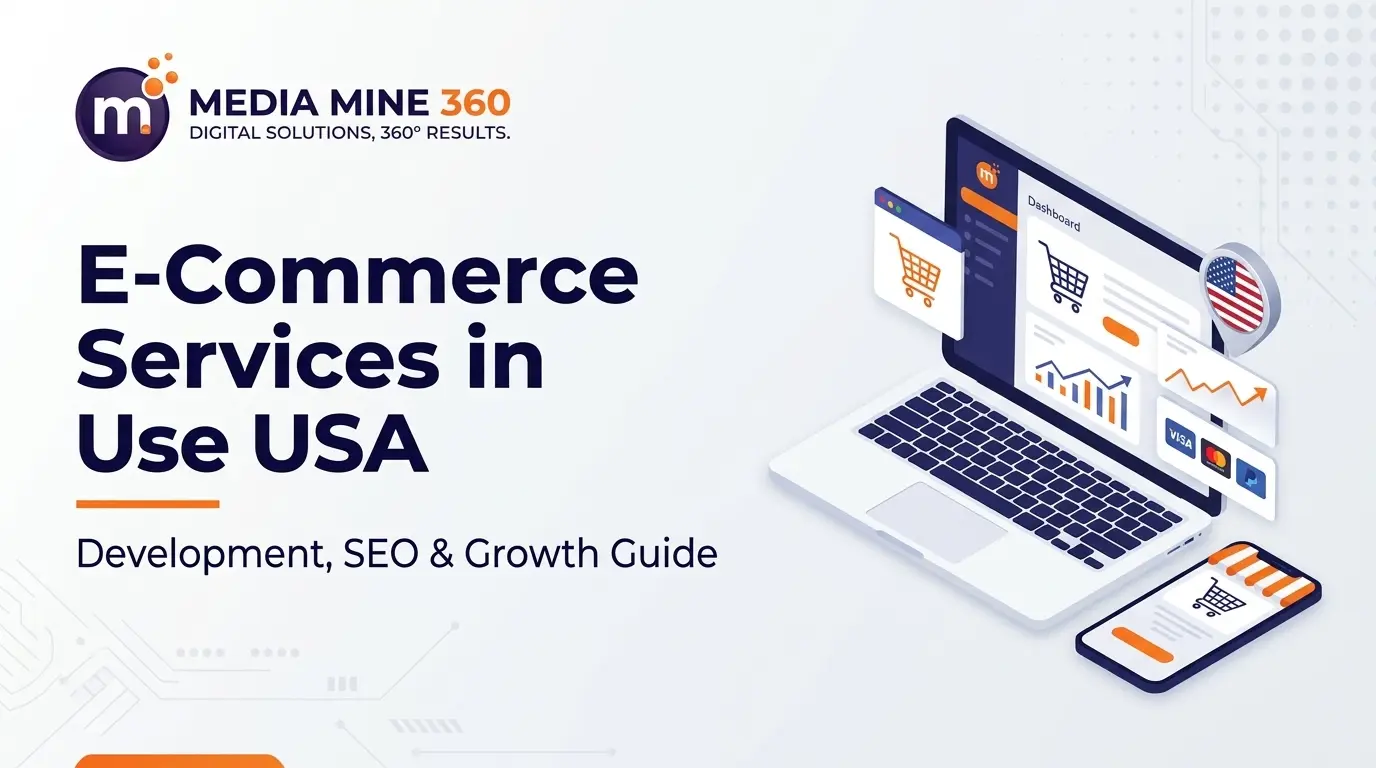
E-commerce services in the USA cover the technical development, platform setup, search optimization, and digital marketing needed to grow an online store. Specifically, a standard store build typically costs $3,500 to $25,000+, while ongoing growth retainers range from $1,500 to $7,500+ per month. Whether you sell directly to consumers (B2C), supply other businesses (B2B), or manage multiple storefronts, choosing the right services ensures your site generates consistent profit rather than empty clicks.
In addition, this practical guide breaks down what modern e-commerce services include and how top platforms compare. Consequently, you will learn what drives real project budgets in the US market and how to turn first-time visitors into loyal buyers.
What Are E-Commerce Services?
Simply put, e-commerce services are the technical, creative, and marketing solutions used to launch, run, and scale an online business. Because every brand faces unique bottlenecks, most e-commerce roadmaps rely on six core pillars:
- Store design and development: First, this covers building a fast, mobile-first layout, clear navigation, and an easy checkout flow.
- Platform setup and migration: Next, specialists launch your store on Shopify, WooCommerce, or Adobe Commerce, or safely move data from an older site without losing rankings.
- System integrations: Furthermore, developers connect payment gateways (Stripe, PayPal, Apple Pay), shipping carriers, ERP, CRM, and inventory software.
- E-commerce SEO: In addition, SEO experts optimize product and category pages so buyers searching on Google find your store first.
- E-commerce marketing: Meanwhile, marketing teams run Google Shopping ads, social campaigns, email/SMS flows, and conversion rate optimization (CRO).
- Security and maintenance: Finally, ongoing support manages SSL certificates, PCI compliance, software patches, backups, and uptime monitoring.
However, you rarely need every single service on day one. Instead, most successful stores launch with clean architecture and basic SEO and then add paid ads, ERP tools, and retention campaigns as sales grow.
When Do You Need Custom E-Commerce Development in the USA?
Custom e-commerce development means building tailored features, checkout rules, and backend connections around your exact workflows rather than using a rigid pre-built template. While a standard theme works well for a small catalog with simple shipping, custom engineering becomes essential when you need:
- Tiered B2B and wholesale pricing: For example, showing custom price lists, bulk discounts, or net payment terms to logged-in business buyers.
- Interactive product builders: Similarly, supporting custom bundles, personalization options, or multi-part product configurators.
- Real-time ERP and warehouse sync: As a result, stock counts, order updates, and returns stay accurate across multiple warehouses and retail stores.
- Custom checkout and shipping logic: Moreover, handling freight quotes, split shipments, age checks, or state-by-state tax rules smoothly.
- High-speed custom storefronts: Above all, removing bloated third-party apps that slow down mobile pages and hurt conversion rates.
Which E-Commerce Platform Should You Choose?
Ultimately, the best e-commerce platform depends on your catalog size, internal tech team, and long-term growth plans. Therefore, comparing the top three options side by side makes your choice much clearer:
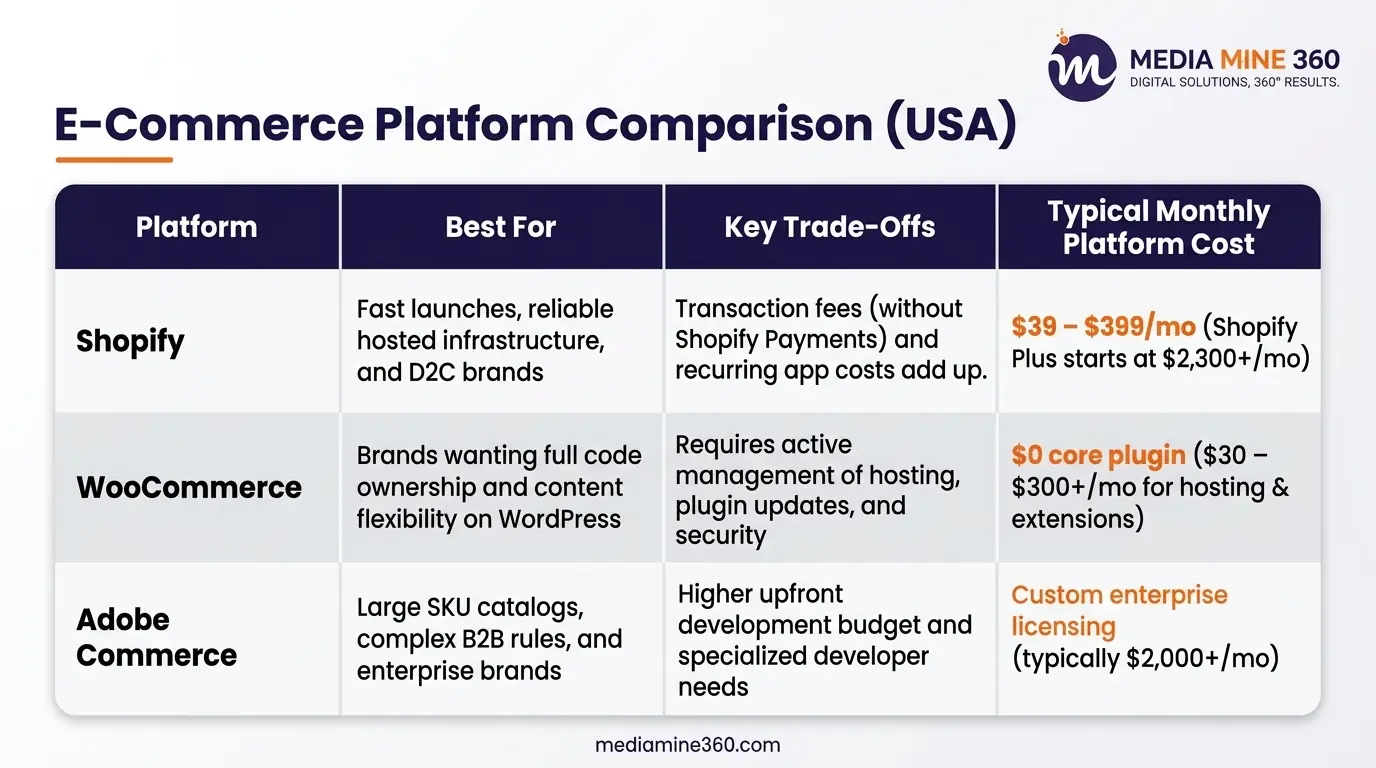
If you are still deciding between the top two choices for a small or mid-sized brand, our detailed comparison of Shopify vs. WooCommerce breaks down total costs, customization limits, and SEO control.
How Do B2B, B2C, and Mobile Commerce Requirements Differ?
Because retail shoppers and wholesale buyers purchase differently, each sales model requires distinct storefront features:
- B2C (Business-to-Consumer): First, retail stores focus on clear product photos, customer reviews, easy return policies, and one-tap mobile checkout.
- B2B (Business-to-Business): In contrast, wholesale portals need company accounts, bulk SKU order forms, custom quote requests, and manager approval steps.
- Mobile Commerce: According to Statista and Shopify data, mobile devices drive over 65% to 70% of US online store traffic. Consequently, stores need sub-2.5-second mobile load times and thumb-friendly filters. Furthermore, brands with frequent repeat orders can boost loyalty through dedicated mobile apps; explore our app development services if a native iOS or Android shopping app fits your roadmap.
| Practical Takeaway: When a growing US distributor moves away from manual phone and spreadsheet orders, combining retail and wholesale catalogs onto one platform with automated stock rules cuts order mistakes and speeds up repeat B2B reorders. |
What Do E-Commerce SEO Services in the USA Include?
E-commerce SEO improves your store’s technical health, category structure, and product pages so high-intent shoppers find your products in Google search results. Unlike paid ads—where traffic stops as soon as you pause your budget—organic search builds compounding, high-margin traffic over time. Specifically, a strong SEO strategy includes:
- Buyer-intent keyword mapping: First, matching commercial search terms to the exact right category and product pages so your URLs never compete against each other.
- Scalable site architecture: Next, keeping every product within three clicks of the homepage using clean URLs and breadcrumb links.
- Unique product and category copy: In addition, writing original descriptions, specs, and buying guides that answer real customer questions.
- Technical SEO and structured data: Furthermore, improving Core Web Vitals, crawl budgets, canonical tags, and Product, Offer, Review, and FAQ schema.
- Authority and digital PR: Finally, earning trusted backlinks from niche blogs, gift guides, and industry review sites.
5 Common E-Commerce SEO Mistakes That Stall Growth
- Copying supplier descriptions: First, publishing identical manufacturer text across hundreds of items triggers duplicate content filters and hurts rankings.
- Unchecked filter URLs: Second, letting size, color, and price filters create thousands of indexable URLs wastes Google’s crawl budget.
- Ignoring mobile Core Web Vitals: Third, heavy, unoptimized images and stacked tracking scripts slow down mobile product pages and lower conversions.
- Deleting out-of-stock URLs: Fourth, removing sold-out product pages throws away earned backlinks instead of keeping the page live with restock alerts.
- Treating local and national SEO identically: Lastly, brands with physical showrooms or regional warehouses miss local buyers when they skip Google Business Profile optimization.
If you are vetting partners to handle technical fixes and organic growth, our guide on how to find the best SEO agency in the USA outlines the exact benchmarks and red flags to check before signing.
Which E-Commerce Marketing Channels Actually Drive Sales?
Bringing visitors to your site is only half the job. Therefore, profitable stores balance paid acquisition with conversion rate optimization (CRO) and repeat-buyer retention:
- Email and SMS lifecycle flows: For instance, recovering lost sales through automated abandoned cart reminders, welcome offers, and reorder prompts.
- Google Shopping and Performance Max: Similarly, capturing ready-to-buy shoppers who are actively comparing prices and specs.
- Paid social discovery: Meanwhile, reaching new audiences on Instagram, TikTok, and Pinterest with short product videos.
- Conversion rate optimization (CRO): As a result, refining product page layouts, free-shipping thresholds, and checkout steps helps more existing visitors buy.
For a wider look at balancing paid, organic, and retention channels, see our practical guide to digital marketing in the USA.
How Much Do E-Commerce Services Cost in the USA?
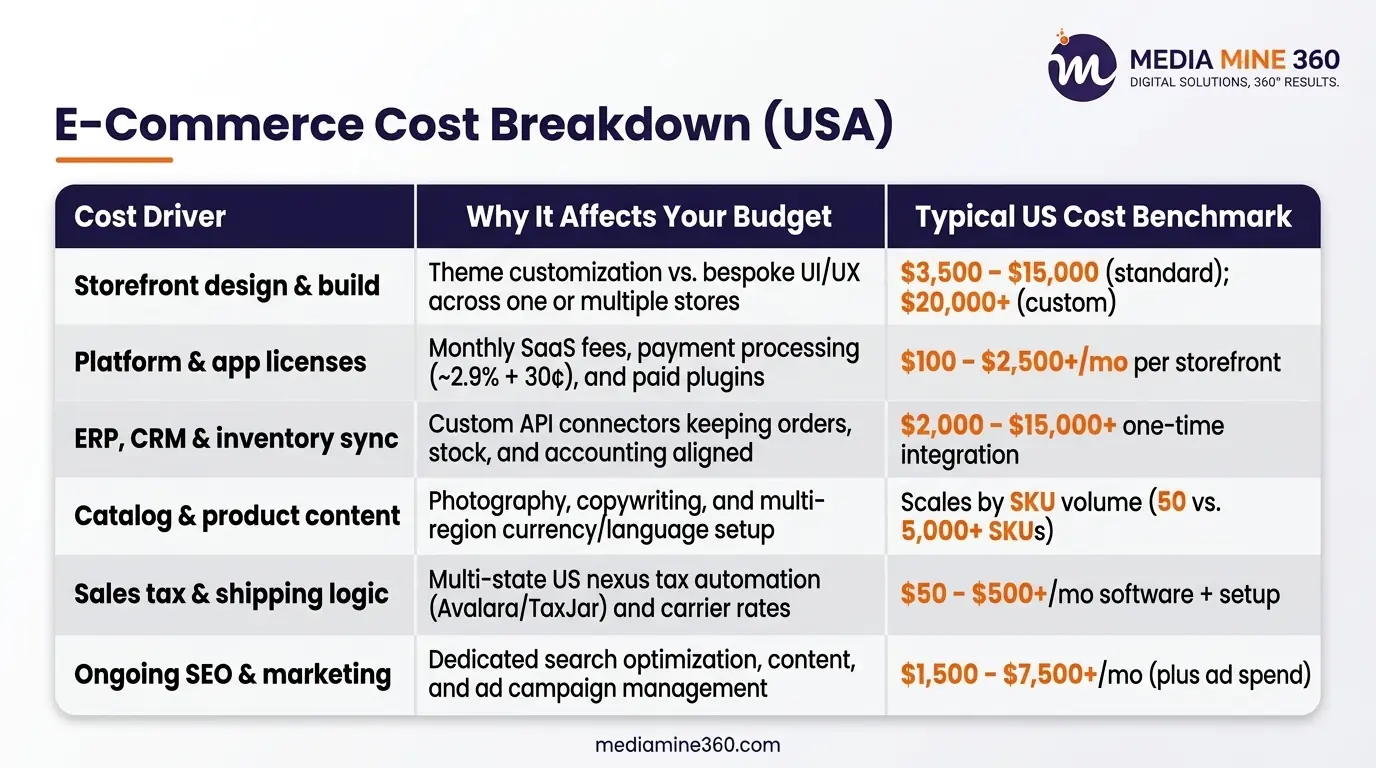
In the US market, launching a custom-designed small-to-mid-sized online store generally costs $3,500 to $25,000+. By contrast, enterprise builds with ERP integrations or multi-store setups range from $25,000 to $100,000+, while ongoing SEO, CRO, and ad management retainers typically run $1,500 to $7,500+ per month.
Furthermore, if you operate multiple storefronts or marketplace channels, your total cost depends heavily on how much backend infrastructure you share:
| Planning Your Budget? Not sure what your build or migration will cost? Share your catalog size and platform goals with Media Mine 360 to request a tailored project estimate. |
4 Ways to Control Multi-Store Costs
- Centralize inventory and order routing: First, manage stock across all storefronts and marketplaces from one central dashboard.
- Use a modular design system: Second, reuse shared templates and components across sister brands instead of coding each site from scratch.
- Prove unit economics on one store first: Third, validate your conversion funnel before expanding into new regions or niches.
- Choose scalable architecture early: Finally, picking the right platform up front avoids costly re-platforming migrations 12 to 18 months later.
How Do You Protect E-Commerce Brand Assets and IP?
Because online stores are easy to scrape and copy, protecting your intellectual property (IP) early prevents costly brand dilution. Specifically, take these six practical steps:
- Register your trademark: First, file your brand name and logo with the United States Patent and Trademark Office (USPTO) to unlock brand registry tools on major marketplaces.
- Protect original media: Next, keep dated raw source files of your product photos, videos, and copy, and register flagship works with the S. Copyright Office.
- Publish clear website terms: In addition, display explicit copyright notices and terms of service governing how your product data may be used.
- Monitor for copycats: Meanwhile, run periodic reverse-image searches and brand alerts to catch cloned storefronts or unauthorized sellers.
- Enforce DMCA takedowns: Furthermore, submit Digital Millennium Copyright Act (DMCA) notices to web hosts and marketplaces when stolen photos appear.
- Lock down store security: Finally, enforce two-factor authentication (2FA), limit admin access, and patch plugins promptly to prevent data breaches.
Note: Intellectual property laws vary by jurisdiction and business model; consult a qualified IP attorney for legal advice.
What Makes a High-Converting E-Commerce Website?
According to Baymard Institute research, the average online shopping cart abandonment rate hovers around 70%, largely due to slow page speeds, unexpected fees, or complicated checkouts. Therefore, if your store gets steady traffic but few orders, audit your site against these eight essentials:
- Sub-2.5-second mobile speed: First, pages must load quickly on cellular connections without layout shifts.
- Effortless search and filtering: Second, predictive search and clear product attributes help buyers narrow down SKUs in seconds.
- Complete product pages: Third, crisp multi-angle photos, sizing specs, verified reviews, and upfront pricing build immediate trust.
- Upfront shipping and return terms: Fourth, delivery estimates and return policies should be visible before checkout begins.
- Frictionless guest checkout: Fifth, first-time buyers must be able to purchase without mandatory account registration.
- Modern payment wallets: Sixth, support credit cards alongside Apple Pay, Google Pay, PayPal, and Buy Now, Pay Later (BNPL).
- Active HTTPS and trust signals: Seventh, display valid SSL encryption and clear customer support contact details.
- Clean technical SEO: Eighth, maintain unique meta titles, structured data, and indexable category hierarchies.
How to Choose an E-Commerce Services Provider in the USA
Before hiring an agency or development partner, evaluate every candidate against six practical criteria:
- Multi-platform objectivity: First, verify they build across Shopify, WooCommerce, and Adobe Commerce so they recommend what fits your goals.
- Integration track record: Second, confirm they have connected stores to your specific ERP, CRM, or 3PL fulfillment software.
- Post-launch growth support: Third, check whether they offer technical SEO, CRO, and marketing alongside initial store development.
- QA and security standards: Fourth, ask how they manage staging environments, load testing, and ongoing security patches.
- Relevant portfolio results: Fifth, review live e-commerce stores and measurable improvements in speed, rankings, or conversion rates.
- Itemized proposals: Finally, ensure the quote clearly separates design, custom engineering, third-party licenses, and monthly retainers.
For a deeper vetting checklist, read our guide on how to choose a reliable web development company. Similarly, if your operations require custom workflows or middleware, explore our overview of custom software development benefits.
Frequently Asked Questions
What are the best e-commerce platforms for a US business?
Shopify, WooCommerce, and Adobe Commerce are the top three platforms for US businesses. Specifically, Shopify suits fast D2C launches, WooCommerce offers full customization on WordPress, and Adobe Commerce handles large enterprise B2B catalogs.
How long does it take to build an e-commerce website?
Generally, a standard store built on a customized theme takes 3 to 6 weeks. In contrast, a custom e-commerce build with ERP integrations, B2B pricing rules, or large data migrations takes 8 to 16+ weeks.
Is e-commerce SEO worth the investment?
Yes. While paid ads deliver immediate clicks, e-commerce SEO builds compounding organic visibility for high-intent product searches, which lowers your blended customer acquisition cost over time.
Can I run B2B and B2C sales from the same online store?
Yes. Platforms like Shopify Plus, WooCommerce (with B2B extensions), and Adobe Commerce allow you to serve retail shoppers and wholesale buyers from one backend using customer-group pricing and bulk order forms.
Do I need a mobile app in addition to a mobile-friendly website?
Start with a fast, mobile-optimized website first. Afterward, a native mobile app makes sense once you have a loyal base of repeat customers who benefit from push notifications and one-tap reordering.
How do I protect my online store from content and brand theft?
First, register your trademark with the USPTO and keep dated source files for original photos and copy. Additionally, monitor search engines for copycats and file DMCA takedown notices whenever stolen assets appear.
Need a Second Opinion on Your Store’s Architecture or SEO?
Whether you are planning a new US storefront, migrating platforms, or trying to uncover why existing traffic is not converting into orders, Media Mine 360 helps growing brands map out practical technical and SEO roadmaps. Explore our e-commerce solutions or request a free store & SEO audit today to see where your biggest growth opportunities sit.