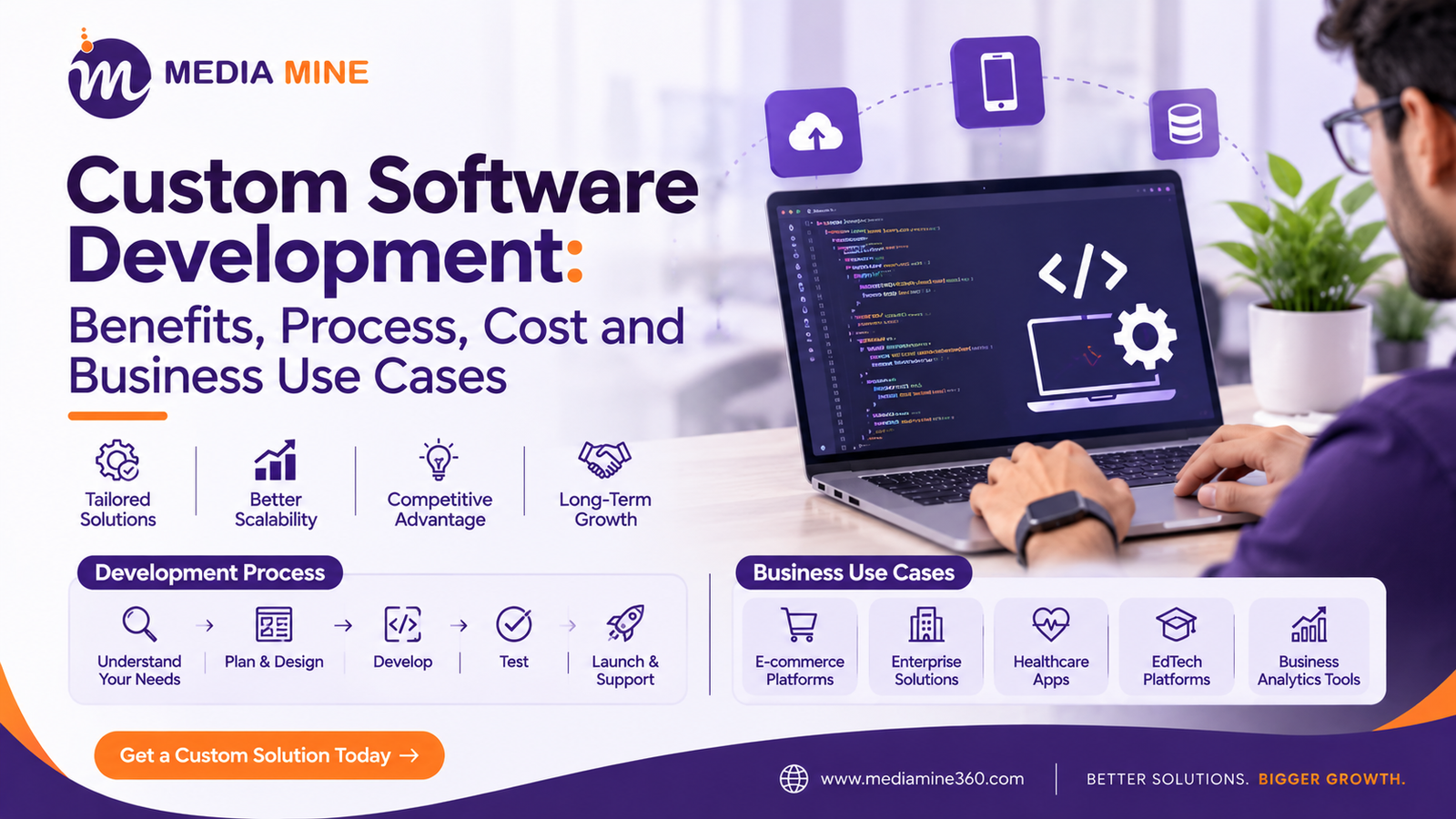
Quick answer: Custom software development is the process of planning, designing, building and maintaining software made for one organization’s specific workflows. Businesses choose it to automate manual work, connect their tools, scale without per-user fees and own their technology. In 2026, projects typically cost $15,000 to $40,000 for a focused tool, $40,000 to $120,000 for a mid-sized system and $120,000 to $250,000+ for enterprise platforms.
Key takeaways
- Custom software fits your exact workflow, whereas off-the-shelf tools make you adapt to them.
- Business process automation, integration, scalability and ownership are the biggest wins.
- A proper software development process has seven stages, from discovery to maintenance.
- Maintenance costs roughly 15–25% of the build cost per year.
- An MVP is the safest start, and this works for small businesses too.
- Moreover, the right partner matters more than the lowest price.
Why Growing Businesses Outgrow Generic Tools
Picture a Monday morning at a growing business. Orders arrive on WhatsApp, while payments are tracked in one spreadsheet. Meanwhile, stock sits in another file, and customer details live in someone’s phone. As a result, three people spend half their day copying data from one place to another.
Nothing is wrong with the team. In fact, the tools simply were not built for how the business works. This is the moment custom software development stops being a “nice-to-have” and becomes a growth decision.
What This Guide Covers
Here you will learn what custom software is and when it makes sense. We also explain how the process works, what it costs in 2026 and how to choose a partner. By the end, you will know whether it suits your business and what to do next.
What Is Custom Software Development?
Custom software development is the design, creation, deployment, and maintenance of software built specifically for a particular business, team or process. People also call it bespoke or tailor-made software.
Think of it like clothing. Off-the-shelf software is a ready-made suit, so it fits many people acceptably but nobody perfectly. Custom software, on the other hand, is tailored to your measurements.
Custom software solutions can take many forms:
- Web applications and customer portals
- Mobile apps for customers or field staff
- Internal dashboards and reporting tools
- CRM, ERP, HRMS and inventory systems
- Booking, billing and payment platforms
- Integrations that connect your existing tools
- AI-powered features such as recommendations, chatbots and forecasting
Custom Software vs Custom Business Software vs Enterprise Software
These terms overlap, so here is a simple distinction:
| Term | Meaning | Typical User |
|---|---|---|
| Custom software | Any software built for a specific need | Any business |
| Custom business software | Custom tools that run internal operations (sales, HR, finance, inventory) | SMEs and mid-size firms |
| Enterprise software solutions | Large, multi-department, high-security platforms | Large organizations |
Why Businesses Need Custom Software: 8 Warning Signs
Growth exposes the limits of generic tools. Therefore, if you recognize three or more of these signs, it is time to evaluate custom software:
- Manual work piles up, so staff spend hours on data entry, reports and follow-ups.
- Data is scattered across five or six disconnected apps. As a result, nobody sees the full picture.
- Licence costs rise with every new user, even though most features go unused.
- Spreadsheets hold critical processes together. Consequently, one broken formula can stop operations.
- Customers ask for features your current tools cannot deliver.
- Your process is unique, which means every tool forces you into workarounds.
- Security or compliance needs exceed what standard products offer.
- Finally, one vendor controls your pricing, features and future.
Benefits of Custom Software Development
1. It Fits Your Workflow Exactly
Custom business software mirrors how your team actually works. Because there are no unused menus and no missing features, adoption is faster. Training is also shorter, and mistakes drop.
2. Business Process Automation
Business process automation is where custom software often pays back fastest. Approvals, invoicing, stock alerts, reminders and reports can all run automatically. For example, a task that takes a person 20 minutes can take software two seconds, and it never makes typing errors.
3. Scalability on Your Terms
Many SaaS products charge more as you add users, records or features. In contrast, custom software is built for your growth path. Therefore, adding users does not automatically multiply your monthly bill.
4. Seamless Integration
Through APIs, your software can connect with accounting tools, payment gateways, CRM, e-commerce stores and messaging platforms. The result is one connected system instead of a dozen isolated apps.
5. Better Security and Compliance
You control access levels, encryption, audit logs and data storage location. This matters most for finance, healthcare and education. Likewise, any business that handles sensitive customer data benefits.
6. A Real Competitive Advantage
When every competitor uses the same generic tools, they all offer the same experience. A custom platform, however, lets you deliver faster service and smarter features. In addition, your customer journey becomes harder to copy.
7. Lower Long-Term Cost
Custom software needs a higher upfront investment. However, you avoid recurring per-user licences, paid add-ons and expensive workarounds. Over three to five years, the total cost of ownership is often lower for businesses with stable, specific needs.
8. Ownership and Control
In most agreements, you own the source code and decide the roadmap. As a result, no vendor can discontinue a feature or raise prices overnight.
Custom Software vs Off-the-Shelf Software
Short answer: choose off-the-shelf software when your needs are standard and speed matters most. Choose custom software when your process is unique, you need deep integrations or software is central to your business model.
| Factor | Custom Software | Off-the-Shelf Software |
|---|---|---|
| Fit to your needs | Built for your workflow | Generic, one-size-fits-all |
| Upfront cost | Higher | Lower |
| Long-term cost | Often lower at scale | Recurring fees grow with users |
| Time to start | Weeks to months | Immediate |
| Scalability | Designed for your growth | Limited by vendor plans |
| Integrations | Fully customizable | Limited to supported apps |
| Competitive edge | Unique to you | Same as every competitor |
| Ownership | You own it | You rent it |
| Support | From your development partner | From the vendor’s support team |
A Simple Decision Framework
Ask yourself these five questions:
- Does a ready-made tool cover at least 80–90% of what we need?
- Is our process a competitive advantage, or just routine admin?
- Are we paying for many licences we barely use?
- Also, do we need integrations that standard tools do not support?
- Finally, will software be part of what we sell to customers?
If you answer “no” to the first question and “yes” to most of the rest, custom software is likely the better investment. In practice, many businesses use a hybrid approach. They keep off-the-shelf tools for common tasks and build custom software for what makes them different.
Custom Software Development Process
The software development process is a structured sequence of stages, usually discovery, planning, design, development, testing, deployment and maintenance, that turns an idea into a working product. A disciplined process separates predictable projects from expensive surprises.
Step 1: Discovery and Requirements Analysis
First, the team studies your goals, users, current workflow and pain points. Typical deliverables include a scope document, a feature list and a roadmap. This is the most important stage, since unclear requirements are the leading cause of budget overruns.
Step 2: Planning and Architecture
After that, engineers choose the technology stack and design the system architecture. They also plan integrations and set the timeline. Good teams flag technical risks here, before those risks become expensive.
Step 3: UI/UX Design
Next, wireframes and clickable prototypes show how the software will look before any code is written. Good design drives adoption, because a hard-to-use tool will be ignored however powerful it is. If this stage is new to you, read our explainer on what UI/UX design is and why it matters.
Step 4: Development
Then developers build the frontend, backend, database and integrations. Most modern teams work in Agile sprints of two to three weeks. Consequently, you see real progress regularly and can adjust direction early.
Step 5: Testing and Quality Assurance
Meanwhile, testers check functionality, performance, security and usability across devices and browsers. Fixing a bug at this stage costs far less than fixing it after launch.
Step 6: Deployment and Launch
Finally, the software goes live on your chosen cloud or server infrastructure. Launches are often phased, starting with a small user group. Data migration and team training usually happen at this point too.
Step 7: Support and Maintenance
Even after launch, software needs monitoring, updates and security patches. Improvements based on real usage matter as well. Therefore, treat this stage as part of the project, not an afterthought.
Custom Software Development Cost in 2026
How much does custom software development cost? In 2026, most projects fall between $15,000 and $250,000+, depending on scope. There is no single price because every project is different. Still, these ranges give a realistic starting point.
| Project Size | Examples | Estimated Cost (USD) | Typical Timeline |
|---|---|---|---|
| Small | Internal tool, simple portal, basic automation | $15,000 – $40,000 | 2–4 months |
| Medium | CRM, booking platform, inventory system | $40,000 – $120,000 | 4–8 months |
| Large / Enterprise | ERP, multi-role platform, fintech or AI-driven system | $120,000 – $250,000+ | 8–14+ months |
These are broad industry estimates, not fixed quotes.
Where the Budget Usually Goes
| Stage | Typical Share of Budget |
|---|---|
| Discovery and planning | 5–10% |
| UI/UX design | 10–15% |
| Development | 40–50% |
| Testing and QA | 10–15% |
| Deployment | 5% |
| Project management | 10% |
What Affects Software Development Cost?
- Features and complexity matter most, because each module, user role and workflow adds effort.
- Platforms also play a part, since web only costs less than web plus iOS and Android.
- UI/UX depth counts too. For instance, a custom design system costs more than a template.
- Integrations add work, especially payment gateways, ERP, CRM, SMS and third-party APIs.
- Security and compliance raise the price through audits, encryption and regulatory requirements.
- Technology choice matters, as mainstream stacks are cheaper to build and maintain than niche ones.
- Team model and location also change the rate. This comparison of freelancer vs. web development agency shows the trade-offs.
- Maintenance is the final factor, so budget roughly 15–25% of the initial cost per year.
Hidden Costs Many Businesses Miss
- Cloud hosting and storage that grow with usage
- Third-party API and subscription fees
- Data migration from old systems
- Staff training and change management
- Additionally, security audits and penetration testing
- Lastly, future feature requests and scaling work
A Simple ROI Example
The Manual Cost Calculation
Imagine a business where three staff members spend about 15 hours per week each on manual order entry and reporting. That adds up to 45 hours weekly, or roughly 180 hours a month. At an average loaded cost of $8 per hour, this equals about $1,440 per month in manual effort.
Furthermore, the business pays around $600 per month in licences for tools that only partly fit. Altogether, it loses about $2,040 monthly, or roughly $24,500 per year.
Payback Period
Now suppose a $30,000 custom automation tool removes most of that work. In this case, it could pay for itself in roughly 15 to 18 months. After that, it keeps saving money every month. This is only an illustration, so run the same calculation with your own numbers.
How to Keep Software Development Cost Under Control
- Start with an MVP. Build the core features first, then expand using real user feedback.
- Write a clear scope. In particular, separate “must-have” from “nice-to-have.”
- Use proven technology instead of experimental tools.
- Freeze requirements during each sprint to avoid scope creep.
- Insist on a detailed estimate that breaks costs down by feature or milestone.
- Plan phases, so you release value early and fund the next phase from the results.
Custom Software Development for Small Businesses
Yes, small businesses can afford custom software. The idea that it is only for large enterprises is outdated. Thanks to cloud hosting, open-source frameworks and phased delivery, software development for small businesses is far more accessible today.
Where Should a Small Business Start?
The smart approach is to pick one high-impact problem and solve it first. For instance, you could begin with one of these:
- An order tracking system for a growing online store
- A client portal that removes endless email chains
- An automated quotation and invoicing module
- Alternatively, a booking and scheduling system for a service business
- Or a simple dashboard that combines sales, stock and cash flow
How to Scale After Phase One
Once the first tool proves its value, expand step by step. The return from phase one helps fund phase two. In this way, the financial risk stays low while the system grows with your business.
Examples of Custom Software Solutions (Business Use Cases)
| Industry | Custom Software Example | Key Benefit |
|---|---|---|
| Retail and E-commerce | Inventory, order and customer management | Fewer stock errors, faster fulfilment |
| Healthcare | Patient records and appointment system | Better data security and patient flow |
| Education | Student portal and learning management system | Centralized records and communication |
| Logistics | Fleet tracking and dispatch platform | Real-time visibility, lower fuel costs |
| Finance | Loan, billing or payment platform | Compliance and secure transactions |
| Real Estate | Property listing and CRM system | Faster lead handling and follow-up |
| Manufacturing | Production and supply chain dashboard | Less downtime and waste |
| Hospitality | Reservation and guest management system | Higher occupancy and smoother service |
| Professional Services | Project, time and billing platform | Accurate billing, better utilization |
Many of these solutions also include a customer-facing mobile experience. Therefore, if your plan involves an app, explore our app development services to see how mobile fits into a wider software strategy.
Popular Technologies Used in Custom Software Development
You do not need to be technical. Even so, knowing the basics helps you ask better questions.
| Layer | Common Options |
|---|---|
| Frontend | React, Angular, Vue.js |
| Backend | Node.js, Python (Django), PHP (Laravel), .NET, Java |
| Mobile | Flutter, React Native, Swift, Kotlin |
| Database | PostgreSQL, MySQL, MongoDB |
| Cloud | AWS, Google Cloud, Microsoft Azure |
| Extras | REST APIs, AI/ML models, payment and messaging integrations |
Ask your partner why they recommend a stack and how it affects cost, hiring and maintenance. A good answer is specific to your project, not a generic sales line.
How to Choose a Custom Software Development Company
The best custom software development company understands your business problem, communicates clearly, prices transparently and supports you after launch. Use this checklist:
- Relevant experience: look for case studies in your industry or a similar problem.
- Discovery-first approach: good partners ask questions before quoting.
- Clear communication: in addition, expect regular updates, defined milestones and one point of contact.
- Transparent pricing: a line-by-line estimate beats a vague lump sum.
- Technical depth: also check for modern stacks, security practices and scalable architecture.
- Post-launch support: ask about maintenance and improvement plans.
- Code ownership: you should own the source code and documentation.
- Reviews and references: finally, speak to past clients if you can.
Looking for a local partner? Here is what to check when evaluating a software house in Lahore. To see what a full-service team can deliver, browse our custom software development services.
Questions to Ask Before You Sign
- Who will actually work on my project, and what is their experience?
- How do you handle changes in scope?
- What does your testing and QA process look like?
- Who owns the source code, designs and data?
- What is included in post-launch support, and what does it cost?
- Lastly, can I see a similar project you have delivered?
Common Mistakes to Avoid
- Skipping discovery leads to rework. As a result, budgets overrun.
- Building everything at once is risky, so launch an MVP first.
- Choosing only on price often backfires, because the cheapest quote becomes the most expensive.
- Ignoring maintenance leaves software insecure and outdated.
- Leaving users out is a mistake, since the people who use the software should shape it.
- Unclear ownership causes disputes. Therefore, confirm code, hosting and data ownership in writing.
- Having no success metrics makes ROI hard to prove. Instead, decide upfront how you will measure hours saved, errors reduced or revenue gained.
Is Custom Software Development Worth It?
It is worth it when software directly supports your revenue, efficiency or customer experience, and when ready-made tools force expensive compromises. On the other hand, it is not necessary if a standard product already meets about 90% of your needs.
Here is a quick test. First, add up the hours your team loses each month to manual work. Then include the licence fees you pay for tools that only partly fit. If that number is high and growing, custom software usually pays for itself.
Ready to Plan Your Custom Software Project?
The most reliable way to get a realistic scope and budget is to talk to an experienced team. At MediaMine360, we help businesses move from idea to launch with clear discovery, thoughtful design and dependable development. When you are ready, contact our team to discuss your project and receive a transparent estimate.
Frequently Asked Questions (FAQs)
What is custom software development?
Custom software development is the process of designing and building software specifically for one organization’s needs. In other words, it replaces a generic, ready-made product with one made for you.
What are the benefits of custom software development?
The main benefits are a perfect fit with your workflow, business process automation and scalability. In addition, you get better integrations, stronger security and full ownership. Over time, it also costs less than recurring licences.
How much does custom software development cost?
Small projects typically cost $15,000 to $40,000, while mid-sized systems cost $40,000 to $120,000. Enterprise platforms, however, can reach $120,000 to $250,000 or more. Ultimately, the final cost depends on features, design, integrations, security needs and team.
How long does custom software development take?
A small project takes about 2–4 months, and medium projects need 4–8 months. Large systems, however, can take 8–14 months or more.
What is the custom software development process?
It usually includes discovery, planning and architecture, UI/UX design and development. After that come testing, deployment, and ongoing support and maintenance.
What is the difference between custom software and off-the-shelf software?
Off-the-shelf software is built for a mass market and is available immediately. Custom software, by contrast, is built for one business. Therefore, it fits better and scales further, but it needs more time and upfront investment.
Is custom software development suitable for small businesses?
Yes. Small businesses can start with one focused tool or an MVP and expand over time. This keeps the initial cost manageable.
Is custom software more secure than off-the-shelf software?
It can be, because you control the architecture, access rules and compliance measures. Nevertheless, security still depends on how well the software is built and maintained.
How much does custom software maintenance cost?
Plan for about 15–25% of the initial development cost per year. This budget covers updates, security patches, hosting support and small improvements.
What is business process automation?
Business process automation uses software to perform repetitive tasks automatically. Examples include approvals, invoicing, reporting and notifications. As a result, staff can focus on higher-value work.
Do I own the source code of custom software?
In most agreements, yes. Even so, always confirm this in your contract before the project starts.
How do I choose a custom software development company?
Check relevant experience, communication quality and pricing transparency. Technical skills, post-launch support and code ownership terms matter as well. Finally, ask to speak with previous clients.
Final Thoughts
Custom software development is not only a technology decision. It is a business decision about how you want to work, grow and compete. When your workflows, customers and ambitions outgrow generic tools, software built around your needs can save time and cut costs. It can also open new opportunities.
In short, start with a clear problem and build in phases. Budget for maintenance, and choose a partner who treats your goals as their own. Done well, custom software becomes an asset that grows in value as your business grows.