A website can introduce your business to the world, but turning online visitors into paying customers requires much more than an attractive design. In today’s competitive digital landscape, businesses need a connected strategy that brings together website development, search engine optimization, paid advertising, social media marketing, and conversion optimization.
Many businesses invest in building websites and running advertising campaigns but still struggle to generate consistent enquiries and sales. The reason is often a disconnected digital presence. Their website, marketing campaigns, and customer experience operate independently rather than working towards a shared business goal.
A successful digital growth strategy changes this approach. It connects every digital touchpoint, attracts the right audience, builds trust, and guides potential customers towards taking action.
Whether you are launching a new business or looking to strengthen an established brand, understanding how to connect your online presence with your sales objectives can make a significant difference.
1. Why Having a Website Is Not Enough to Grow Your Business
Your website is often the first place potential customers visit when they want to learn about your business. However, simply having a website does not guarantee traffic, enquiries, or sales.
Imagine a business with a professionally designed website that receives very few visitors. Even if the website looks impressive, its ability to generate customers remains limited without an effective strategy to attract and convert its audience.
Several factors can prevent a website from delivering meaningful results:
- Limited search visibility: Potential customers cannot easily discover your business through search engines.
- Poor user experience: Complicated navigation, slow-loading pages, or confusing layouts discourage visitors.
- Unclear messaging: Visitors cannot immediately understand what your business offers or why they should choose it.
- Weak calls to action: Without clear next steps, potential customers may leave without making an enquiry.
- Lack of trust signals: Missing testimonials, business information, and credible content can make visitors hesitant.
Your website should function as an active business asset rather than simply an online brochure.
To understand how a professionally developed website contributes to business credibility and customer engagement, read our guide on How a Professional Website Helps Your Business Grow.
2. Build a Website That Turns Visitors into Customers
A successful business website should do more than display information. It should communicate value, establish credibility, and make it easy for visitors to take the next step.
Create a Professional and User-Friendly Design
First impressions matter. A clean, modern, and consistent website design helps communicate professionalism and makes your brand easier to recognise.
Organise information logically, maintain consistent branding, and ensure visitors can quickly find the products, services, and information they need.
Make Your Website Mobile-Friendly
A significant portion of online browsing takes place on mobile devices. Your website should provide a smooth experience across smartphones, tablets, and desktop computers.
Responsive layouts, readable typography, accessible navigation, and properly sized buttons help visitors interact with your website comfortably.
Improve Website Loading Speed
Slow websites can frustrate visitors and interrupt the customer journey. Optimised images, efficient coding, reliable hosting, and proper caching can improve website performance.
Website speed also contributes to user experience and is among the factors Google considers in its page experience systems.
Write Content That Communicates Value
Your website content should clearly explain what you offer, who you help, and how your services solve customer problems.
Instead of relying on generic promotional statements, focus on specific benefits, relevant information, and answers to common customer questions.
Add Clear Calls to Action
Every important page should guide visitors towards a relevant action.
Examples include:
- Request a Quote
- Book a Consultation
- Shop Now
- Contact Our Team
- Explore Our Services
Strategically placed calls to action help visitors understand what to do next.
Businesses looking to establish a stronger online presence can explore our Website Development Services for professional, responsive, and business-focused website solutions.
3. Use SEO to Attract Customers Who Are Already Searching
Search engine optimization (SEO) helps your website appear when potential customers search for products, services, and information related to your business.
Unlike advertising, which generally generates visibility through paid placements, SEO focuses on earning relevant visibility in organic search results.
A well-planned SEO strategy can help businesses attract visitors who are actively interested in what they offer.
Understand Your Audience’s Search Behaviour
Start by identifying what your potential customers search for online.
Think about their questions, challenges, purchasing requirements, and the words they use when looking for solutions.
For example, someone searching for website development services may use queries such as:
- Website development company
- Professional website design services
- E-commerce website development
- Website development for small businesses
Understanding these searches helps you create content that matches actual customer needs.
Conduct Strategic Keyword Research
Keyword research identifies relevant search terms that can help your website reach the right audience.
Focus on keywords that reflect your services, audience interests, and business objectives. Consider search intent alongside search volume and competition rather than choosing keywords based on popularity alone.
Optimise Your Website Pages
On-page SEO makes your content easier for search engines and users to understand.
Important elements include:
- Relevant page titles and meta descriptions.
- Clear heading structures.
- Descriptive URLs.
- Naturally integrated keywords.
- Internal links between related pages.
- Optimised images and descriptive alt text.
Improve Technical SEO
Technical SEO helps search engines discover, crawl, and understand your website.
Pay attention to website indexing, XML sitemaps, mobile usability, broken links, HTTPS security, page performance, and structured data where appropriate.
Publish Helpful and Relevant Blog Content
Regularly publishing useful articles allows your business to address customer questions and target additional relevant search queries.
For example, a web development agency could publish guides about website costs, website redesigns, e-commerce platforms, and common website problems.
This approach can build topical relevance, support internal linking, and create additional opportunities to attract organic traffic.
Explore our Search Engine Optimization and Digital Marketing Services to discover how strategic SEO can strengthen your website’s visibility and reach.
4. Accelerate Business Growth with Paid Advertising
SEO builds long-term organic visibility, while paid advertising can help businesses reach targeted audiences and generate traffic more quickly.
Platforms such as Google Ads and Meta Ads provide different opportunities depending on your business objectives.
Use Google Ads to Reach High-Intent Customers
Google Ads allows businesses to appear when users search for relevant products or services.
For example, a person searching for a digital marketing agency may already be considering professional marketing support.
Targeting relevant search terms, writing compelling advertisements, and directing users to appropriate landing pages can help businesses connect with potential customers at the right moment.
Use Facebook and Instagram Ads to Build Demand
Meta Ads help businesses introduce their products and services to audiences based on relevant targeting options.
These platforms can support several objectives, including:
- Increasing brand awareness.
- Generating leads and enquiries.
- Promoting products and offers.
- Driving website traffic.
- Reaching new audiences.
The most effective campaign depends on your audience, offer, creative content, and business goals.
For a deeper understanding, explore our guide on Meta Ads Services: How to Generate Qualified Leads and Sales.
Implement Retargeting Campaigns
Not every visitor makes a purchase or enquiry during their first interaction with your business.
Retargeting allows businesses to reconnect with eligible audiences who have previously interacted with their website or advertising content.
These campaigns can reinforce brand awareness and encourage interested users to reconsider an offer.
Track Conversions Instead of Just Clicks
A campaign receiving thousands of clicks is not necessarily successful if those visitors do not take meaningful action.
Monitor important performance indicators such as cost per lead, conversion rate, qualified enquiries, customer acquisition cost, and return on advertising spend.
This helps you understand whether advertising is contributing to actual business objectives.
5. Build Brand Awareness Through Social Media Marketing
Your website may be the destination where customers explore your business, but social media often provides the first opportunity to discover your brand.
Platforms such as Facebook, Instagram, LinkedIn, and TikTok allow businesses to communicate with audiences, share useful information, and build stronger relationships.
Choose the Right Social Media Platforms
Not every platform is suitable for every business.
A B2B company may benefit from LinkedIn, while a fashion or lifestyle brand may find Instagram and TikTok more relevant.
Choose platforms based on your audience, industry, content format, and marketing objectives.
Create Consistent and Valuable Content
An effective content strategy should balance promotional material with educational, informative, and engaging posts.
Consider publishing:
- Product and service highlights.
- Educational tips and industry insights.
- Customer testimonials and success stories.
- Behind-the-scenes content.
- Short-form videos and reels.
- Answers to frequently asked questions.
Consistency helps audiences become familiar with your brand and understand the value you provide.
Maintain a Recognisable Brand Identity
Consistent colours, typography, visual styles, and messaging make your business easier to recognise across different platforms.
Professional graphic design plays an important role in creating a cohesive brand experience.
Connect Social Media with Your Website
Your social media profiles should make it easy for interested users to visit your website, explore your services, or contact your business.
Use relevant links, clear profile information, and campaign-specific landing pages to connect social engagement with meaningful business actions.
For more insights, read our article on 7 Shocking Social Media Marketing Secrets.
6. Optimise Your Website to Convert More Leads into Sales
Attracting visitors is only one part of digital growth. The next challenge is encouraging those visitors to become customers.
Conversion optimization focuses on improving the experience users have when interacting with your website and making it easier for them to complete valuable actions.
Understand How Visitors Interact with Your Website
Tools such as Google Analytics 4 can help you understand how users arrive at your website, which pages they visit, and what actions they complete.
Use this information to identify pages that receive attention but generate limited enquiries or sales.
Simplify Forms and Checkout Processes
Long enquiry forms and complicated checkout processes can create unnecessary barriers.
Ask only for essential information, make instructions clear, and remove unnecessary steps from the customer journey.
Create Dedicated Landing Pages
A landing page should focus on a specific campaign, service, or offer.
For example, a Google Ads campaign promoting website development should direct visitors to a relevant website development landing page rather than a general homepage.
This creates a more consistent experience between the advertisement and the destination page.
Build Trust Before Asking for a Sale
Customers are more likely to consider businesses that communicate credibility and professionalism.
Include relevant testimonials, portfolio examples, case studies, clear contact details, and transparent service information.
These elements help visitors make more informed decisions.
Continuously Test and Improve
Conversion optimization is an ongoing process.
Experiment with different headlines, page layouts, button placements, and messaging. Compare results and use actual user behaviour to guide improvements.
7. Measure Performance and Improve Your Digital Growth Strategy
A digital growth strategy should be guided by measurable results rather than assumptions.
Tracking performance helps businesses understand which marketing activities are contributing to their objectives and where improvements are needed.
Here are some important metrics to monitor:
Website Traffic: Understand how many people visit your website and which channels bring them there.
Organic Search Performance: Monitor search impressions, clicks, keyword visibility, and organic traffic through Google Search Console.
Conversion Rate: Measure the percentage of visitors who complete a desired action, such as submitting an enquiry or purchasing a product.
Cost Per Lead: Calculate how much your advertising campaigns spend to generate each lead.
Customer Acquisition Cost: Understand the overall cost of acquiring a new customer.
Return on Advertising Spend (ROAS): Evaluate the revenue generated relative to advertising expenditure.
Google Analytics 4, Google Search Console, and advertising platform reporting tools can provide valuable insights into these metrics.
Regularly reviewing performance allows businesses to identify opportunities, refine campaigns, and make better marketing decisions.
8. How All Digital Marketing Services Work Together
The real strength of a complete digital growth strategy comes from connecting different marketing channels rather than treating each one as an independent activity.
Consider a business launching a new online service.
Its website provides a professional destination where visitors can explore the offer. SEO helps the website attract organic visitors searching for related services. Google Ads reaches users with relevant search intent, while Meta Ads introduces the business to new audiences.
Social media content builds brand familiarity and communicates value. Conversion-focused landing pages then make it easier for interested visitors to submit enquiries.
Each activity supports a different stage of the customer journey.
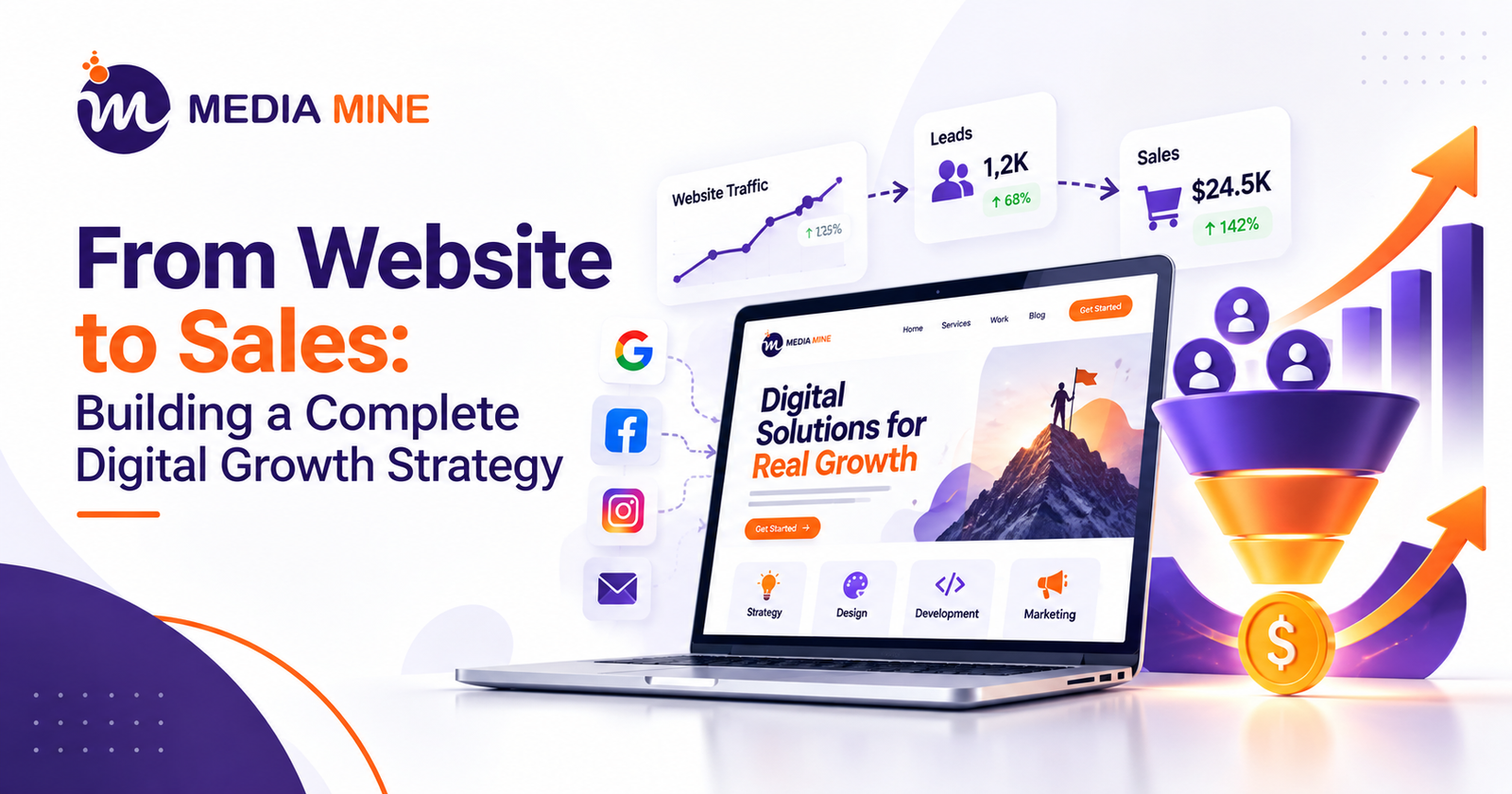
The complete digital growth journey:
- Brand Awareness: Introduce your business to relevant audiences.
- Website Traffic: Bring interested visitors to your website.
- Lead Generation: Encourage visitors to enquire or express interest.
- Customer Conversion: Turn qualified opportunities into customers.
- Business Growth: Use performance insights to improve and scale your strategy.
When these activities work together, businesses can create a more consistent and measurable digital experience.
Explore the complete range of Digital Marketing Services offered by Media Mine 360 to understand how different digital solutions can support your business objectives.
9. Final Thoughts: Turn Your Digital Presence into Business Growth
Building a successful online presence requires more than launching a website or publishing content on social media. It requires a clear strategy that connects visibility, customer experience, marketing activities, and business objectives.
A professional website establishes your digital foundation. SEO helps potential customers discover your business. Paid advertising expands your reach, while social media strengthens brand recognition and engagement. Conversion optimization brings these efforts together by making it easier for visitors to take action.
At Media Mine 360, we believe that effective digital marketing should contribute to meaningful business growth. Our services include SEO, website development, social media marketing, Google and Meta advertising, e-commerce solutions, and graphic design.
Whether you are building your online presence from the beginning or looking to improve your existing digital performance, the right strategy can help you move beyond simply attracting visitors.
Ready to turn your website into a stronger source of business opportunities?
Contact Media Mine 360 to discuss your business goals and explore a digital strategy designed around your needs.
Frequently Asked Questions (FAQs)
1. What is a digital growth strategy?
A digital growth strategy is a structured approach to using online channels, technologies, and marketing activities to increase brand visibility, attract potential customers, generate leads, and support business growth.
2. How can a website help generate more sales?
A professionally developed website can showcase products and services, communicate business value, build customer trust, and guide visitors towards making purchases or submitting enquiries.
3. Which digital marketing services does a growing business need?
Most growing businesses can benefit from website development, SEO, social media marketing, and paid advertising. The right combination depends on the business model, target audience, budget, and growth objectives.
4. How do SEO and paid advertising work together?
SEO helps generate organic visibility over time, while paid advertising provides access to targeted audiences through sponsored placements. Together, they can support broader search visibility and customer acquisition goals.
5. How long does it take to see results from digital marketing?
Results depend on the marketing channels, competition, budget, website condition, and campaign objectives. Paid advertising can generate initial traffic quickly, whereas SEO generally requires sustained effort to build organic visibility.
6. How can I measure the success of my digital marketing strategy?
You can evaluate performance through website traffic, organic search clicks, lead generation, conversion rates, customer acquisition costs, and advertising returns. Tools such as Google Analytics 4 and Google Search Console help track important performance indicators.