
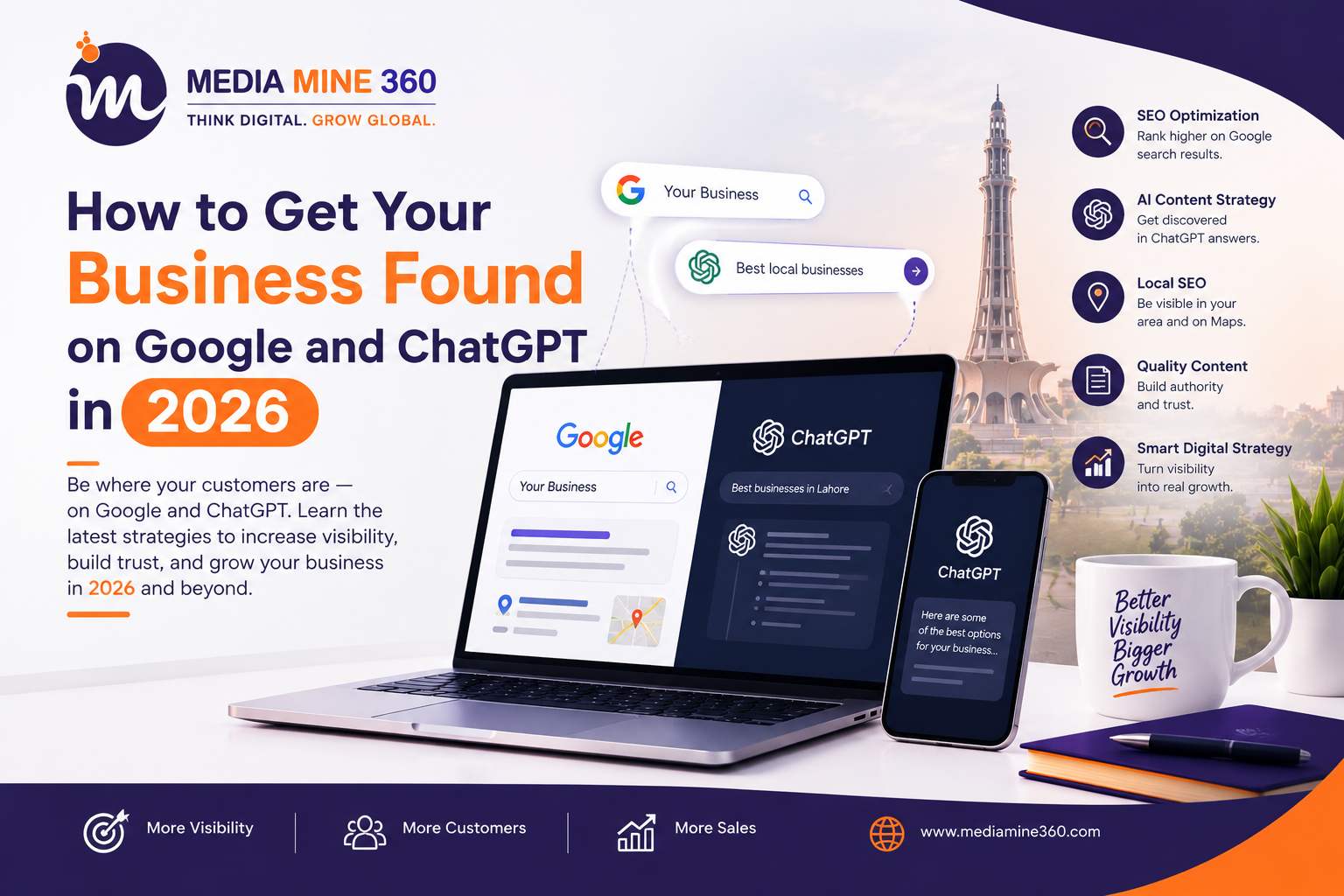
Something changed in how people search, and most business owners haven’t caught up yet.
Search used to mean one thing: type into Google, scroll through blue links, and click one. Now a huge chunk of people just ask ChatGPT, Gemini, or Perplexity a question and take whatever answer pops out often without clicking anything at all. Two names might get mentioned in that answer. If yours isn’t one of them, you never even had a chance.
So this guide is about how to get your business found on Google and ChatGPT in 2026, using three ideas that work together: SEO (Search Engine Optimization), AEO (Answer Engine Optimization), and GEO (Generative Engine Optimization). The names sound technical. They’re really not. Give me a few minutes and they’ll make sense.
Why 2026 Actually Feels Different
I’ll be honest every year someone claims “SEO is dead” or “search is changing forever,” and mostly it’s noise. This time it isn’t.
A few things are genuinely different now:
- AI overviews show up in more than half of all Google searches, and when they do, far fewer people click through to the top result than before.
- ChatGPT is used by hundreds of millions of people every week, and a growing share of them are asking it “which company should I use” type questions instead of googling them.
- Ranking on Google’s first page and getting cited by an AI answer are turning out to be two very different games. Studies have found the overlap between the two is sometimes as low as 12%.
- Some analysts expect traditional search volume to shrink by roughly a quarter by 2026, simply because more people are asking chatbots instead.
None of this means Google is going away. It means your customers now walk through two doors instead of one, and you need to be visible standing at both of them.
SEO, AEO, GEO What Actually Separates Them
Let’s skip the textbook definitions.
| Term | What it really means | What you win |
|---|---|---|
| SEO | Making your site easy for Google to crawl, understand, and rank | A good position in search results |
| AEO | Writing content in a way AI tools can lift out cleanly and quote | Getting directly quoted inside an AI-generated answer |
| GEO | Building your reputation across the whole internet, not just your site | Being remembered and recommended by name |
The part that surprises most people: SEO is largely a “your own website” game. GEO mostly happens somewhere else entirely. AI models don’t just crawl your homepage — they pick up signals from Reddit threads, Quora answers, review sites, comparison blogs, news mentions, all of it. If people are talking about you positively across the web, AI is far more likely to bring your name up when someone asks a relevant question.
And you don’t need three separate campaigns for this. One solid content and reputation strategy, done well, covers all three at once — because content that’s clear, honest, and well-organized tends to win everywhere, not just on one platform.
Part 1: SEO — Still the Foundation Everything Else Sits On
AEO and GEO are built on top of decent SEO, not instead of it. Skip this part and the rest doesn’t hold up.
1. Find Out What Your Customers Actually Type
Your primary keyword should sound like something a real person would type, not a phrase from a company brochure.
- Use a free tool like Google Keyword Planner, or just type your service into Google and look at “People also ask” and the related searches at the bottom.
- Go after long-tail keywords — something like “affordable wedding photographer in Lahore” rather than just “photographer.” They’re easier to rank for, and honestly, they match how people phrase things when they ask an AI a specific question too.
- Sort your keywords by intent. Someone researching is not the same as someone ready to buy, and they need different pages.
2. Get the On-Page Basics Right
Not glamorous, but skipping this costs you later.
- A clear title tag and meta description that actually describe the page
- One H1 heading, stating plainly what the page is about
- A site that loads fast — people (and search engines) both bail on slow pages
- A design that works properly on a phone, since that’s where most searches happen now
- Clean, readable URLs instead of strings of random characters
- Alt text on your images describing what’s actually in them
3. Local SEO Is Not Optional If You Serve a City
For a local business, your Google Business Profile can matter more than your homepage.
- Fill it out completely right category, hours, phone number, real photos, accurate service area.
- Keep your name, address, and phone number identical everywhere it appears online. Even small mismatches confuse both Google and AI tools about who you actually are.
- Ask happy customers for reviews, and reply to all of them good and bad. Reviews carry real weight now, both for ranking and for what AI tools say about you.
4. Backlinks Haven’t Stopped Mattering
A backlink is just another website linking to yours, and it still matters more than people think. One study on AI citation patterns found that sites with a large number of referring domains were far more likely to get cited by ChatGPT than sites with almost none. A few realistic ways to earn them:
- Get listed in directories relevant to your industry
- Write a guest post for a respected blog in your space
- Get mentioned in local news, a podcast, or an industry roundup
- Publish something genuinely useful — a free tool, a guide, original research — that people actually want to link to
Part 2: AEO — Getting Quoted Inside AI Answers
AEO comes down to one goal: when someone asks an AI assistant a question in your space, your content is what it pulls the answer from.
How These Tools Actually Decide What to Cite
When someone asks ChatGPT or Google’s AI Mode a question, the system usually splits it into several smaller sub-questions behind the scenes and searches each one separately, then stitches the pieces together into one answer. That’s why a page trying to cover ten things at once usually loses out to a page that nails one specific question really well.
What tends to get picked up:
- The answer was stated plainly in the first sentence or two, with no long wind-up before getting to the point.
- Clear structure headings, numbered steps, tables. Tables in particular seem to get pulled into AI answers far more often than the same information written as a paragraph.
- A real number, source, or specific detail backing up the claim, not just a vague opinion.
- Plain language that doesn’t need a second read to understand.
A Few Things You Can Actually Do About This
- Add an FAQ section to your key pages, phrased the way a customer would actually ask (“How much does X cost?” “Is X safe for beginners?”).
- Add FAQ and article schema markup. It’s just a bit of code telling search engines and AI tools exactly what your page is about, removing any guesswork.
- Try to answer one question per section instead of blending three ideas into one paragraph. It’s easier for AI to lift out something clean.
- Look at “People Also Ask” boxes for the exact phrasing people (and AI systems) tend to use.
- Keep old pages updated. A page with current numbers and examples gets picked up more than one that’s clearly a few years stale.
Part 3: GEO — Getting AI to Recommend You by Name
Here’s the mental shift that trips people up: GEO isn’t really about your website at all. It’s about your reputation everywhere else.
Roughly 80% of what makes GEO work is positioning and presence across the web — only about 20% is technical work on your own site. AI models form an opinion of your business from a lot of places, not just your homepage.
Where These Models Are Actually Learning About You
- Review sites Google Reviews, Trustpilot, whatever’s standard in your industry
- Reddit and Quora, where people ask for honest recommendations
- “Best of” and comparison articles written by bloggers or review sites
- News coverage and press mentions
- Wikipedia and Wikidata, if you’re notable enough to qualify
- Social media activity
- Your own site and blog, of course
What You Can Actually Do About It
- Try to get included in comparison content “top 10 tools for X” if you’re software or “best plumbers in [city]” if you’re local.
- Show up genuinely, not spamily, where people ask questions in your space Reddit threads, Quora, niche forums. AI tools scan these a lot when forming opinions about brands.
- Push for detailed reviews, not just star ratings. “Fixed my AC in 40 minutes, fair price, explained everything clearly” gives AI tools much more to work with than five stars and nothing else.
- Keep your story consistent. Your About page, social bios, and any press coverage should describe your business the same way it helps AI models connect the dots confidently.
- Go for a Wikipedia or Wikidata entry if you actually qualify. These are still some of the most trusted sources AI models lean on.
- Publish your own data. A small survey, a case study, some numbers unique to your business that’s the kind of thing other writers, and eventually AI, will want to cite because you’re the original source.
The One Thing All Three Actually Agree On
Whether it’s Google deciding how to rank you or an AI model deciding whether to quote you, the underlying question is the same: can this be trusted?
This usually gets summed up as E-E-A-T, Experience, Expertise, Authoritativeness, and Trustworthiness. In practice, that means:
- Real author names and credentials on your content, not “Admin”
- Actual evidence of your work photos, case studies, real before-and-afters
- Clear, accurate contact info and business details, kept up to date
- No exaggerated claims. AI tools are getting better at cross-checking facts across sources, and getting caught out hurts you everywhere at once, not just in one place.
A Simple Weekly Checklist
- Complete and update your Google Business Profile
- Add an FAQ section with a schema to your five most important pages
- Reply to new reviews within 48 hours
- Publish one clear, single-topic page answering a real customer question
- Reach out to one directory, blogger, or publication for a mention
- Answer one question genuinely on Reddit or Quora
- Refresh the numbers and examples on one older page
Small, consistent effort every week beats one big SEO push done once a year. Both Google’s algorithm and AI models seem to reward that kind of steady upkeep.
Bottom Line
You don’t have to choose between showing up on Google and showing up on ChatGPT you need to show up cleanly on both. SEO gets your site seen. AEO gets your best answers quoted. GEO gets your name remembered even in conversations that never touch your site at all.
Get the SEO basics right, write answer-first content for AEO, and put real effort into your reputation across the web for GEO. Do all three consistently enough, and it stops mattering whether the next customer types into Google or asks ChatGPT they end up finding you either way.