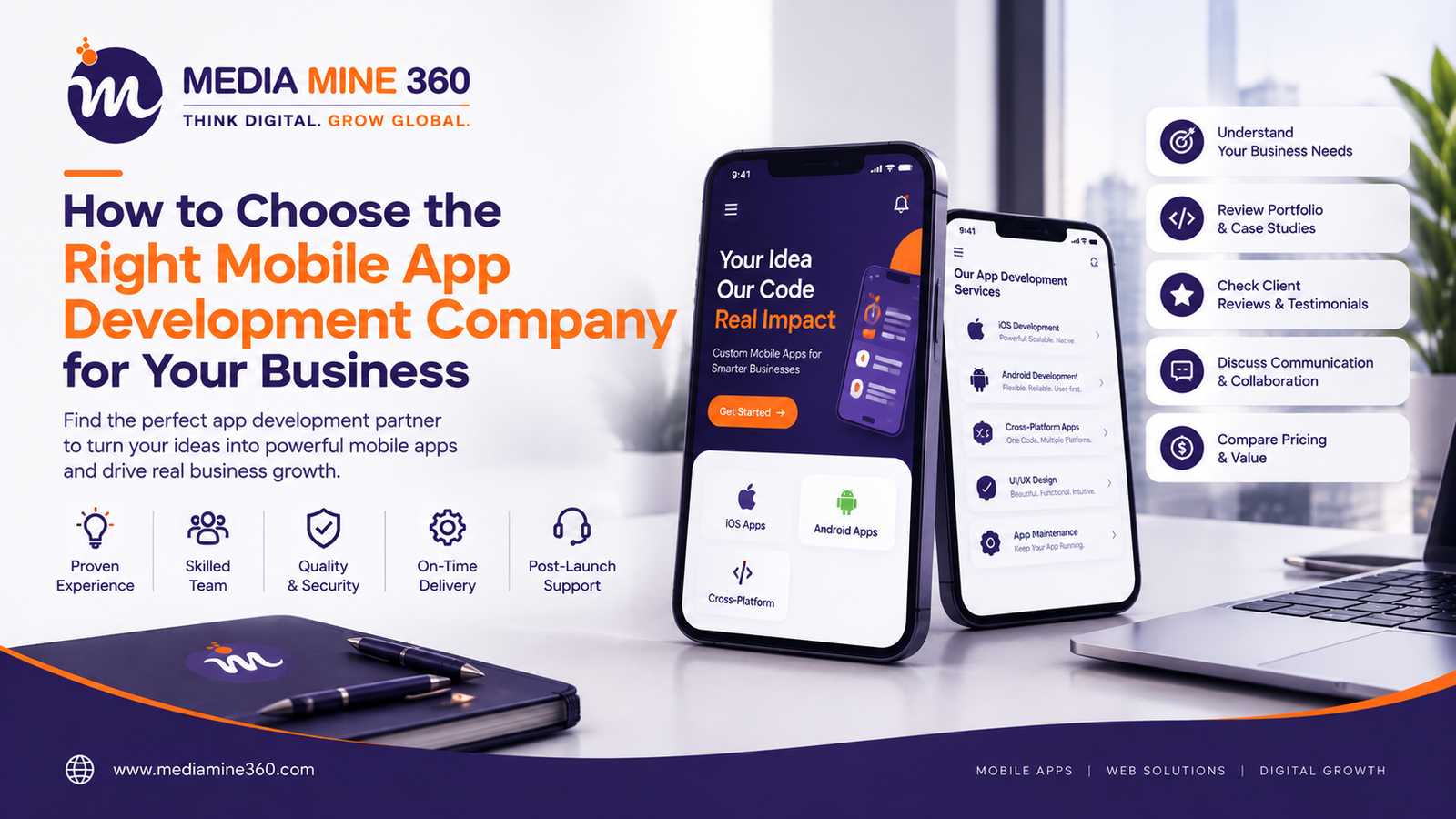
Almost every business today needs a mobile app. Customers spend most of their online time on their phones, so a good app can improve sales, loyalty, and daily operations. However, an app is only as good as the team that builds it.
A poor choice of mobile app development company can leave you with a blown budget, missed deadlines, and buggy software. In some cases, you may not even own the code. On the other hand, a strong partner turns your idea into a product people actually use.
In this guide, you will learn how to evaluate and choose the right partner. We also include specific advice for businesses looking for a mobile app development company in Pakistan, and in particular a mobile app development company in Lahore.
Why Choosing the Right Mobile App Development Company Matters
Building an app is more than writing code. It also involves product strategy, UI/UX design, testing, store submission, and long-term support. Therefore, the company you hire shapes every stage of the project.
A good partner will help you validate your idea before you spend heavily. Moreover, they will build a secure, scalable, and fast product, and they will keep improving it after launch. A weak partner, by contrast, often delivers something that looks fine in a demo but breaks when real users arrive.
Step 1: Define Your Goals Before You Search
Before you contact any company, get clear on your own needs. This step saves time because a good company will ask about them anyway. Besides, clear requirements lead to more accurate quotes.
Start by writing down these points:
- The problem your app solves and who will use it
- The platform you need: Android, iOS, or both
- Your must-have features versus your nice-to-have features
- A realistic budget and timeline
- Your success metrics, such as downloads, orders, or revenue
Above all, keep your first version small. A focused MVP (minimum viable product) costs less and launches sooner. As a result, you get real user feedback before you invest more money.
Step 2: Understand the Types of Mobile App Developers
You will meet several kinds of providers, and each one suits a different need.
Freelancers
Freelancers can work well for small, simple projects with tight budgets. However, one person rarely covers design, backend, testing, and support. Consequently, availability can become a problem.
Small and Mid-Size Agencies
For most businesses, this is the sweet spot. You get a full team of designers, developers, and testers. In addition, you usually receive more personal attention than a large firm offers.
Large Software Houses
Large firms suit complex, enterprise-level projects. Nevertheless, they cost more, and smaller clients sometimes receive less priority.
Many businesses choose local mobile app developers in Pakistan because of competitive pricing, a shared time zone and easy communication. Furthermore, the local talent pool has grown quickly in recent years.
Step 3: Check the Portfolio and Real Experience
A portfolio shows what a company can actually deliver. First, look for live apps that you can download and test yourself. Second, check whether the company has worked in your industry or with a similar business model.
Design quality matters too. A good app feels clean, simple, and consistent. Equally important, it should load fast and run without crashes.
Finally, ask for detailed case studies instead of simple screenshots. A strong case study explains the problem, the approach, the technology, and the results. For example, it might show how an app reduced order time or increased repeat customers.
Step 4: Evaluate Technical Expertise
You do not need to be technical. Still, you should understand the basics of what a competent team offers.
Native Development
Native apps are built separately for Android (Kotlin or Java) and iOS (Swift). As a result, they deliver the best performance and full access to device features. On the downside, they take more time and budget.
Cross-Platform Development
Frameworks such as Flutter and React Native let you build both apps from one codebase. Therefore, development is usually faster and cheaper. For most business apps, this is a very practical choice.
Backend, APIs, and Security
Most apps also need servers, databases, and user accounts. In addition, they often connect to payment gateways, maps, or a CRM. So, ask how the company protects user data, handles logins, and secures payments.
A good company recommends the approach that suits your project. In contrast, a weak one simply pushes whatever it already sells.
Step 5: Look at the Development Process
Professional teams follow a clear and transparent process. Typically, it looks like this:
- Discovery and planning: The team defines requirements, user flows and a roadmap.
- UI/UX design: You approve wireframes and prototypes before coding starts.
- Development: The team builds in short sprints and shows regular demos.
- Testing and QA: Testers check functions, performance, security, and device compatibility.
- Launch: The team submits the app to the stores and handles the review.
- Support and maintenance: The team fixes bugs, updates for new OS versions, and adds features.
Be careful with any company that skips discovery and design and jumps straight to coding. Otherwise, you risk scope creep and expensive rework later.
Step 6: Communication and Transparency
Many failed projects share one root cause, which is poor communication. Therefore, check a few things before you sign a contract. Ask who your main contact will be and how often you will get progress updates. Then find out which tools the team uses, such as Jira, Slack, or weekly calls. Also confirm that you will see staging builds during development.
Communication starts in the sales process. If a company replies slowly or vaguely while it wants your business, it will not improve after payment.
Step 7: Compare Pricing the Smart Way
App development cost depends on complexity, features, platforms, design depth, and team seniority. For this reason, two quotes for the “same” app can differ enormously. Often, the scope is simply not the same.
Use these tips when you compare quotes:
- Ask for a detailed breakdown by feature or milestone.
- Be careful with the cheapest offer, because very low prices usually mean junior teams or hidden extras.
- Clarify what is included, such as design, backend, admin panel, testing, and support.
- Prefer milestone-based payments instead of large upfront payments.
Compared with agencies in the US or Europe, a mobile app development company in Pakistan can offer strong value. However, value does not mean the lowest price. Instead, focus on quality per rupee.
Step 8: Why Location Matters When Choosing a Company in Lahore
Local proximity is not a must, but it has clear advantages. Lahore is one of Pakistan’s biggest tech and startup centers. As a result, it has a deep pool of engineers, designers, and digital specialists.
Working with a mobile app development company in Lahore gives you easy in-person meetings for workshops and demos. Moreover, you share the same time zone and language, so you never wait overnight for answers. The team also understands local user behavior, payment habits, and Urdu-language needs. Finally, urgent problems get solved faster.
If you serve international customers, a Lahore-based team can still work well remotely. Of course, that only works when their process and communication are strong.
Step 9: Check Ownership, Contracts, and Legal Terms
Many businesses skip this step, and that is a costly mistake. Your agreement should clearly say that you own the source code, designs, and assets once you pay. In addition, sign an NDA to protect your idea and business data.
The contract should also cover scope, milestones, and deadlines. Furthermore, it should explain the warranty or bug-fix period after launch, plus who pays for third-party licenses. Lastly, agree on exit terms so you know what happens if you part ways mid-project.
Step 10: Plan for Post-Launch Support and Marketing
Launching is the starting line, not the finish. Apps need regular updates for new Android and iOS versions, security patches and new features. Therefore, ask about maintenance plans and response times before you hire.
An app will not grow by itself either. People must find it first, so plan your promotion early. For example, App Store Optimization (ASO) helps you rank in store searches, and a dedicated landing page explains your app to visitors. Likewise, SEO, social media and paid ads bring in your first wave of users.
A full-service digital marketing agency can help you plan the launch and drive downloads. Otherwise, your app may sit unnoticed in the store.
Red Flags to Avoid
Walk away, or at least dig deeper, if a company shows any of these signs:
- It has no verifiable portfolio or refuses to share client references.
- It promises unrealistic timelines or a fixed price without any discovery phase.
- It is vague about who will actually work on your project.
- It will not let you own the source code.
- It asks for a large upfront payment with no milestones.
- It has no clear plan for testing, security, or maintenance.
Questions to Ask Every Company Before You Hire
Good answers matter more than a polished brochure. So, ask each company these questions:
- Can you show me live apps similar to mine?
- Who will work on my project, and how experienced are they?
- Which technology do you recommend, and why?
- How do you handle changes in scope?
- What does your testing process look like?
- Who owns the code and design files?
- What support is included after launch?
- Can I speak to a past client?
Final Thoughts
The best mobile app development company for your business is not the biggest or the cheapest. Rather, it is the one that understands your goals, communicates honestly, and builds quality software. It should also stay with you after launch. So, take your time, compare three to five options, and check references.
Whether you are searching for mobile app developers in Pakistan or a local partner in Lahore, these steps will help you decide with confidence. Once your app is ready, the team at MediaMine360 can help you get it in front of the right audience through SEO, content, and social media.
Frequently Asked Questions (FAQs)
1. How much does it cost to develop a mobile app in Pakistan?
The cost depends on the app’s complexity, features, platforms, and design. For instance, a simple MVP costs far less than a marketplace or fintech app with a custom backend. Pakistan-based companies generally offer more competitive rates than agencies in Western markets. Still, always ask for a detailed, itemized quote.
2. How long does it take to build a mobile app?
A simple app can take a few weeks to a couple of months. Medium-complexity apps usually need three to six months, while large apps can take longer. In addition, design, testing, and app store approval all add to the timeline.
3. Which is better: native or cross-platform app development?
Native apps offer the best performance and full access to device features. However, they need separate Android and iOS builds. Cross-platform frameworks like Flutter and React Native let you build both from one codebase, which saves time and cost. Therefore, cross-platform is a solid choice for most business apps.
4. How do I find the best mobile app development company in Lahore?
First, shortlist companies with live apps, verified reviews, and a transparent process. Next, meet the team and ask for client references. Then compare detailed proposals from at least three companies. Above all, look for good communication as well as good code.
5. What should I look for when hiring mobile app developers in Pakistan?
Check their experience with your type of app and their technical skills, such as Flutter, React Native, Kotlin, Swift, and backend work. Moreover, review their portfolio, security practices, and post-launch support. Finally, confirm that you will own the source code.
6. Should I hire a freelancer or a mobile app development company?
Freelancers can work for small, simple tasks. For a complete product, however, a company is usually safer. It provides a full team of designers, developers, and testers. Besides, the project can continue smoothly even if one person leaves.
7. Do I need a backend for my mobile app?
Most apps do. If your app has user accounts, stores data, sends notifications, or processes payments, it needs a backend and APIs. For this reason, your development company should plan and price the backend from the start.
8. Will I own the source code of my app?
You should, but only if the contract says so. Therefore, confirm intellectual property ownership before you begin. After final payment, make sure you receive the source code, design files and account credentials.
9. What is an MVP, and should I build one first?
An MVP is a simplified first version with only the core features. Building one lets you test your idea with real users and control costs. As a result, you can improve the product based on feedback before you invest more.
10. How much does app maintenance cost after launch?
Many businesses budget a yearly percentage of the original build cost for maintenance. This covers OS updates, bug fixes, security patches and server costs. So, ask every company about its support plans and pricing before you decide.
11. How can I promote my app after launch?
Combine App Store Optimization, a landing page, SEO, social media and paid ads. In addition, content marketing and influencer partnerships can build trust. A digital marketing partner can manage these channels while you focus on the product.