Most businesses don’t look for custom web app development services because they love software. They go looking because something is stuck. Orders live in spreadsheets, customers email for updates, or a team works around a tool that never quite fits.
You can fix that with a custom web application, but only if you have the right team on a well-scoped project. In this guide, we’ll explain what custom web app development services mean, what affects their price, how the development process goes, and how to choose a development partner with confidence.
What Are Custom Web Application Development Services?
Custom web application development services include planning, designing, building, testing, and maintaining a web browser-based application built for a single company’s specific workflow. The logic, screens, and data structure are designed around how your team and customers actually work, not a template.
Website vs. web app
A website is mostly about information display. People do something through a web application: log in, place orders, track shipments, book appointments, manage accounts, or see live data. Many projects have both. For instance, a marketing site may have a customer portal integrated behind it.
Normal operating range
Typically, a complete service for developing custom web apps includes:
- Requirements gathering provides a true competitive advantage, or if no existing product meets your needs, thencovery
- This service includes defining user roles and data requirements, as well as planning the layout of pages.
- UI/UX design
- front end & back end development
- 3rd Party Integrations (payments, CRM, shipping, accounting), database configuration
- Cross-browser, cross-device testing
- Deployment and support after launch
Not every project necessitates every item. A reputable agency will tell you what to pass on.
Custom Web App vs. Packaged Software
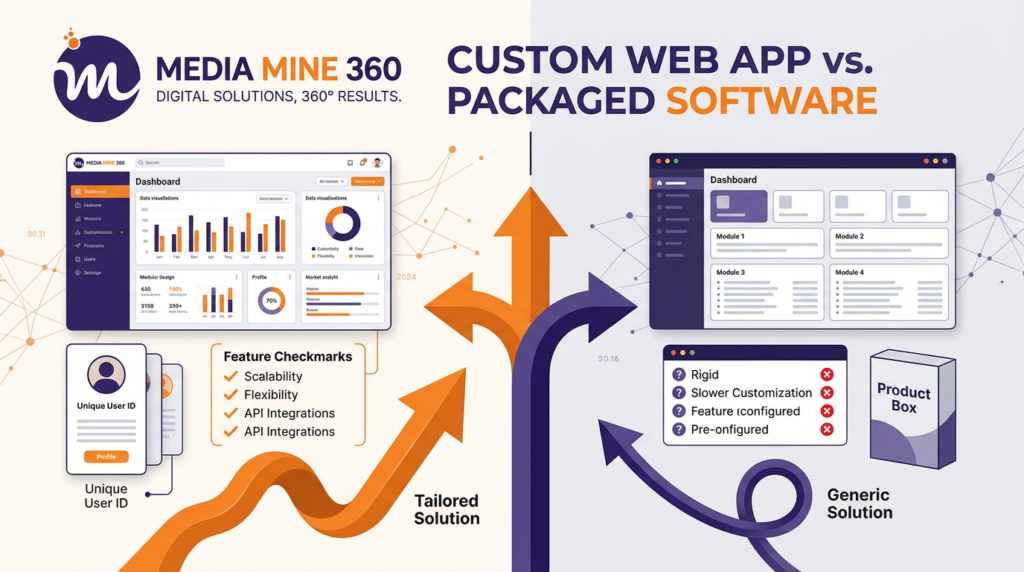
Custom isn’t necessarily better. Often the right first step is to use tools you already have.
Factor packaged software Tailor-made web app
Upfront Cost: Higher Lower
Integrate into your workflow. You adapt to the tool. The tool adjusts to you.
Quick to start Slower, requires planning
Flexibility Restricted to vendor capabilities Designed around your needs
Integrations only what the vendor supports can be made for your system(s).
Vendor roadmap and pricing Ongoing dependencyYour code base and team
It makes more sense to buy a product that already exists that does most of what you need. If your process is a true competitive advantage or no product does it right, custom work is worth the cost.
When to Choose a Custom Web Application
When do custom web app development services pay off?
- You are knitting together several tools and doing manual work in between.
- Your workflow is unusual, and standard software requires awkward workarounds.
- You require customer, vendor, or staff portals with varying permission levels.
- You want to grow. And you need the system to grow with you.
- You want to own the product, not rent access to another person’s product.
Custom e-commerce web apps
The standard store platforms work for a lot of retailers. If you have unusual pricing rules, B2B ordering, bundled products, complex inventory logic, or deep links to warehouse and accounting systems, then a custom e-commerce web application becomes worth talking about. If you’re weighing up store platform vs. custom build, MediaMine360’s e-commerce website development page is a good place to start before you request a consultation.
Custom supply chain web applications
Businesses in the supply chain often operate using spreadsheets, email, and phone calls. Common tasks for custom supply chain web apps are:
- Order & Shipping Tracking Dashboards
- Supplier & Vendor Portals
- Inventory visibility at locations
- Purchase order approvals
- Reporting for managers needing one clear view
The common thread is a single source of truth that replaces a few disconnected files. Don’t commission anything until you have mapped your existing process on paper. And whoever builds the app is going to need that map anyway.
What is the custom web application development cost in the US?
There isn’t a single price. If you are looking for custom web app development services, it will depend on scope. If someone is throwing a fixed number and doesn’t know your requirements, they are guessing. Quotes for the same project can also vary greatly between agencies, because they assume different things.
The key cost drivers are
- Number of features and roles of users. Having logins for admin, staff, and customers is more work than a single user tool.
- Complexity of design. Custom interfaces and deep UX research take more time than simple layouts.
- Integrations: Every connection to payments, ERP, CRM, or shipping systems means more work and testing.
- data and migration. When moving existing records into a new system, it is important to be careful.
- security and regulatory requirements. Effort added by sensitive data or industry requirements. Don’t assume; ask your agency what applies to your sector.
- Maintenance and Hosting. Launch is not the finish. Costs of hosting, updates, and fixes are ongoing.
- Team/Region. Rates vary by team and location, so compare scope and deliverables, not just totals.
A good way to manage cost is to build a small first version with only the features that matter, get it out there, and then add more based on usage. Ask each agency for a phased estimate and a clear list of what is and isn’t included.
Custom Web App Development Process, Step by Step
This ensures a clear process for both sides. Regardless of which custom web app development service you choose, the workflow should be something like this:
- Requirements and discovery The team understands your business, goals, users, and limitations.
- Structure and planning. Pages, navigation, user roles, and data are organized before any design work is done.
- UI/UX Design & Development. The screens are designed and then built with the functionality agreed upon.
- Testing and quality assurance. Check forms, features, responsiveness, and browser compatibility.
- Support and launch. The app goes live, and the team helps to iron out any issues after.
You should see work at checkpoints rather than waiting for one big reveal. Good UI/UX design at step 3 matters more than it sounds, because staff will only use an app that feels easy.
Performance, Security, and SEO: What a Good Build Does Right
Performance
Slow apps annoy users, and public-facing pages suffer. Google’s guidance on Core Web Vitals on the web. Dev explains the loading, interactivity, and stability measures you should be asking your developers about.
Security
Any app where you have logins or customer data needs to have good security practices. OWASP Top Ten is a list of the most common risks in web applications. You can ask a prospective agency how they approach these. Don’t settle for “we take security seriously.”
Visibility on search engines
Many web applications are private, but public pages (landing pages, product pages, and help content) still need to be crawlable. If your app uses a lot of JavaScript, read Google Search Central’s documentation on how Google processes JavaScript and plan your public pages accordingly. It’s much cheaper to build in a search engine-optimized structure than to fix it later. No agency can guarantee rankings, but they can avoid technical errors that hold them back.
Cell
Your app will be used by staff and customers on their phones. Responsive layouts should be in the plan, not added later.
Things to Consider When Hiring a Custom Web App Development Firm
Forget the slogans on the homepage. When you compare a custom web app development company, these are the signals that matter more:
- An open process. Can they explain in layman’s terms what happens from first call to launch?
- Relevante Erfahrung. Ask for examples similar to your project. Look at what the work actually accomplished, not just how it looked.
- A team is either internal or clearly identified. You want to know who is building your app.
- Honest scoping. Good teams push back, suggest a smaller first version, and tell you when off-the-shelf is enough.
- Communication styles. Regular updates and named contacts trump vague promises.”
- Support post-launch. Discover what happens when something goes wrong after the go-live.
- Ownership terms. You should know who owns the code, design files, and hosting accounts.
- Nothing that sounds too good to be true. Red flag: promises of guaranteed rankings, sales, or leads.
Questions to Ask Before You Hire a Web App Development Agency
Have this list handy for your first calls:
- Who will work on my project? Will it be the same people from beginning to end?
- Can you give examples of similar projects? What was your role in them?
- How do you deal with scope changes once the work has begun?
- What is included/excluded in your estimate (design, testing, hosting, training)?
- How do you test the app before you release it?
- What security and data protection measures do you have?
- Who owns the source code and accounts at the end of the project?
- What support do you offer after launch, and how is it priced?
- How will we communicate, and how often will I see progress?
- If money were tight, what would you build first?
See how clearly they answer. Vague answers early mean vague deliveries later.
How to Find Companies for Enterprise-Level Custom Web Solutions
“Enterprise-grade” is a marketing term, so what does it mean to you? Usually it includes role-based access, audit trails, reliable integrations with existing systems, documentation, and a maintenance plan.
To make a shortlist:
- Create a one-page brief with goals, users, key features, integrations, and budget range.
- Check out agency websites, portfolios, and independent reviews.
- Get 3 – 5 scoped proposals from companies so you can compare apples with apples.
- Ensure every team can speak to scale, security, and long-term support, not just design.
Does Location Really Matter? Florida, USA, and Remote Delivery
Not as much as it used to do. Most discovery calls, design reviews, and testing happen online, so an agency doesn’t need to be in your city to work well with you.
The most important thing is straightforward communication, agreed meeting times, and a documented process. See how a team handles time zone differences and what contact channels they use. If you are a US business (Florida included), ask them directly how they would run the project remotely and what you can expect in terms of availability.
Lahore, Pakistan-based MediaMine360 says it works with clients in the UK, US, and other countries via virtual meetings and online collaboration tools.
Why Companies Turn to MediaMine360
MediaMine360 is a web design and digital marketing company in Johar Town, Lahore. It offers web design services like business websites, e-commerce stores, CMS-based websites, website maintenance, and custom web applications to meet a client’s needs. You can also find examples of client web projects on that page.
What businesses can reasonably expect: From agency-published information
- A development team on staff.
- A defined process: discovery, planning, UI/UX design and development, testing, and then launch and support.
- Builds responsiveness for desktop, tablet, and mobile.
- Post-launch development support, with arrangements agreed pre-project commencement.
- SEO, software development, and related servicesunder one roof.
- A free consultation to discuss a project.
Cost, timelines, and support terms are project-dependent, so the best first step is a conversation about your specific needs.
FAQs
What Are Custom Web Apps Development Services?
These are services that design, build, test, and maintain a browser-based application around the needs of one specific organization, such as a customer portal, booking system, internal dashboard, or custom e-commerce platform.
How long does it take to build a custom web application?
Depends on the scope. A narrow first version with a few key features takes a lot less time than a platform with a lot of user roles and integrations. Ask for a phased timeline with milestones, not just an end date.
Is a custom web app SEO-friendly?
Yes, for the parts that face the public. Crawlable pages, a clean URL structure, fast loading, and sensible use of JavaScript all help. Private areas behind a login need not be indexed. No developer can guarantee ranking.
Do I need an agency in my city or state?
No. Most projects can be done remotely as long as communication, meeting time, and documentation are clear. Ask each agency how they would handle your project if it was remote.
What information do I need to provide to get a quote for my business web application?
Tell us about your goals, who will use the app, must-have features, systems it needs to connect to, your preferred timeline, and a budget range. Any reference apps you like help also. The more specific the brief, the closer the quotes are.
Do I need support after the app is launched?
Yes, software needs updates, fixes, and security attention over time. Agree on the scope of support and the cost before the project starts.
Summary
The right custom web app development services won’t try to push you into the biggest build possible. They will help you define the problem, start with what’s important, build it carefully, and support it after launch. Use the cost drivers and questions above to compare agencies on substance, not slogans.
If you’re planning a custom web application, a customer portal, or a custom e-commerce build, you can speak to MediaMine360 about your project.
Contact MediaMine360:
- Website: com
- Email: info@mediamine360.com
- Phone (Pakistan): +92 324 9434701
- WhatsApp (UK): +44 7424 505173
- Address: 147, Block Q, Phase 2, Johar Town, Lahore, Punjab 54000, Pakistan