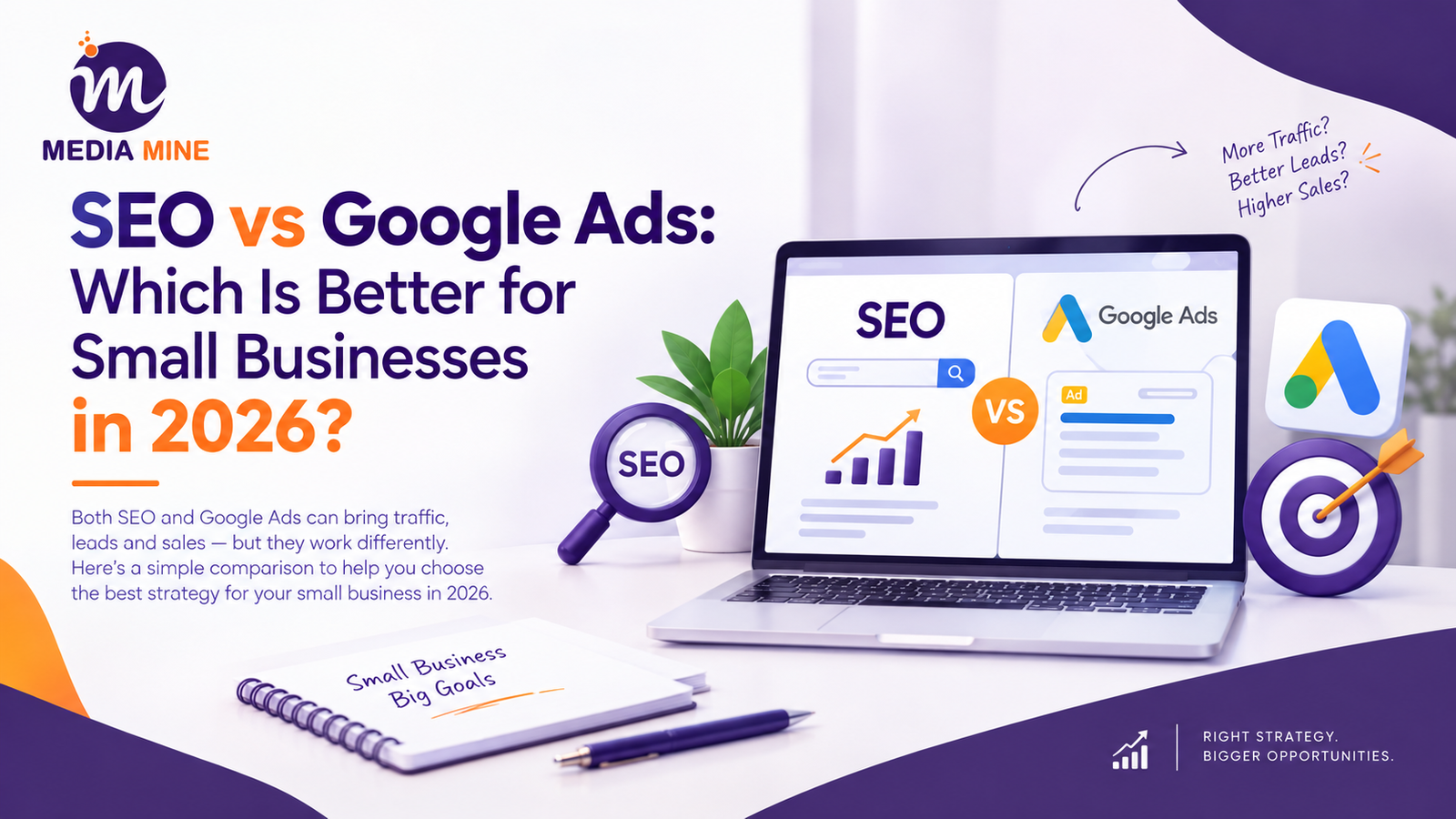
The short answer: neither wins in every situation. Choose SEO if you can wait a few months for steady, compounding growth and a lower cost per lead over time. Choose Google Ads if you need enquiries this week or want to test an offer quickly. For most small businesses, the smartest plan is a mix: a modest ad budget for fast leads while professional SEO builds a long-term source of customers.
Here is a quick way to think about it. If you need leads within days or weeks, or you want to test a new offer, start with Google Ads. If you can wait four to six months and want a lower cost per customer over time, start with SEO. A local service business usually does best with SEO plus a small ads budget, and if you have a very tight budget and no proper website yet, fix the website first and then move on to SEO.
If you are deciding where to put your marketing money in 2026, this guide breaks down the real differences in cost, speed, trust, results and risk, and shows how to choose for your own business.
SEO vs Google Ads at a Glance
How they work. SEO earns you a place in the organic results, while Google Ads pays for a spot at the top of the page.
Speed. Ads can bring visitors within hours of launch. SEO usually needs three to six months for early traction, and longer for competitive terms.
Cost. SEO needs upfront and ongoing effort (content, technical work, links) but has no fee per click. Google Ads charges per click, so costs rise with competition.
When you stop. Rankings can keep bringing traffic after the work is done, while ad traffic stops the moment the budget stops.
Trust. Organic listings are often seen as more credible. Ads are clearly labeled, so some users skip them.
Scalability. SEO grows slowly, then compounds. Ads scale quickly, but so does the bill.
Best for. SEO suits long-term growth and lower acquisition costs. Google Ads suits fast leads, promotions and testing.
Main risk. With SEO, the risk is a slow start and algorithm changes. With Google Ads, it is wasted spend from poor targeting.
What Is SEO?
Search engine optimization (SEO) is the process of improving your website so it appears higher in unpaid search results when people look for what you sell. It combines several parts:
- Technical SEO: site speed, mobile usability, crawlability, secure hosting and clean structure.
- On-page SEO: page titles, meta descriptions, headings, content and internal links.
- Content: pages and articles that answer what your customers are really searching for.
- Off-page SEO: reputation, mentions and quality backlinks from other websites.
- Local SEO: your Google Business Profile, reviews and location signals, which matter a great deal for service businesses.
If you want a closer look at how this works in practice, our SEO services page explains what a complete optimization process covers.
What Are Google Ads?
Google Ads is Google’s pay-per-click advertising platform. You choose keywords, write ads and set a budget, and your ad can appear above or below organic results whenever someone searches for those terms. You pay when a person clicks, not when the ad is shown.
That makes Google Ads attractive for small businesses: you can start small, target a specific city, pause campaigns any time and see results quickly. The trade-off is that the traffic is rented. When you stop paying, the visitors stop too.
Cost: Which Is Cheaper for a Small Business?
Cost is usually the first question, and the honest answer is that it depends on your industry and competition.
Google Ads cost. According to WordStream’s 2026 benchmarks, the average cost per click on search campaigns across industries is about $5.42, and the average cost per lead is about $66.69. Here is a simple illustration using those averages: if you wanted roughly 100 leads a month, you could expect to spend something like $6,600 a month on ads. In expensive industries such as legal, insurance or home services, clicks can cost far more. These are averages, not promises, so treat them as a starting range and not a forecast.
SEO cost. SEO has no charge per click, but it is not free. You invest in technical fixes, content, optimization and ongoing improvements. The cost is front-loaded and the return builds over time. A page that ranks well can keep sending visitors month after month without a new payment for each one.
The practical takeaway: Google Ads is predictable and fast but gets expensive in competitive markets. SEO takes longer to pay off but usually becomes the cheaper source of leads over a 12-month period or longer, as long as it is done well and kept up.
Speed: How Fast Will You See Results?
Google Ads can bring traffic the same day your campaign is approved. You still need time to refine keywords, ad copy and landing pages, so expect a learning period of a few weeks before the numbers settle.
SEO is slower. New or small websites commonly need three to six months to see meaningful movement, and competitive keywords can take longer. The reward is that results tend to compound: each new page and each earned link strengthens the whole site.
If you have a launch, a seasonal rush or cash flow pressure, that difference in speed matters. If you are building a business for the next five years, SEO deserves a serious place in your plan.
Trust and Click Behavior
People know that results marked as ads are paid for. Many searchers deliberately scroll past them, especially for research-heavy decisions such as choosing a service provider. Organic rankings tend to feel more earned, and ranking alongside strong reviews and helpful content builds credibility.
That does not mean ads do not work. For buyers who are ready to act, such as “emergency plumber near me”, a well-written ad with a clear offer and a good landing page can convert very well. Ads win when intent is high and timing is urgent.
What AI Search Changes in 2026
Google’s AI Overviews now appear on a share of searches and answer many informational questions directly on the results page. Research from Seer Interactive found that click-through rates dropped sharply on queries showing AI Overviews during 2025, then began to recover in early 2026. Their data also suggests paid click-through rates have been more stable than organic ones.
What does this mean for a small business?
- Focus SEO on commercial and local intent. Searches like “best accountant in [city]” or “buy [product] online” still send people to websites. Pure “what is” queries are more exposed to AI answers.
- Build trust signals. Reviews, clear expertise, author information and consistent business details help search engines and AI tools understand who you are.
- Do not rely on one channel. Because organic and paid results behave differently on the same page, a mix is safer than betting everything on one.
Which Is Better for Your Type of Business?
Local service businesses (plumbers, clinics, salons, lawyers)
Start with local SEO and a complete Google Business Profile, then add a small Google Ads budget for urgent, high-intent searches. Local customers search constantly, and ranking in the map results can bring a steady stream of calls.
E-commerce stores
Use SEO for category and product pages that earn long-term traffic, and use ads to promote bestsellers, launches and sales. A fast, well-structured store matters for both channels, so review your e-commerce setup before spending heavily on traffic.
Consultants, agencies and B2B companies
SEO tends to win because buyers research before they contact anyone. Helpful guides, case studies and service pages build trust over time. Ads can support specific campaigns where the cost per lead is justified by deal size.
New startups and new offers
Google Ads is a fast way to test what people respond to before you invest in long-term content. Use the data from your ads (which keywords convert, which messages work) to guide your SEO plan.
Seasonal or event-based businesses
Ads usually fit better because timing is short. Use SEO to prepare a stable base for the rest of the year.
Highly competitive niches
Both channels will be expensive. Look for specific, long-tail searches where you can compete, and consider SEO as the main channel so you are not paying very high prices for every click.
What Should You Choose Based on Budget?
- Very small budget: put money into your website basics and local SEO first. If you can spare a little, run a tightly targeted ad campaign in one city for one service.
- Moderate budget: split between SEO (for long-term growth) and a focused ads campaign (for immediate leads).
- Growing budget: keep SEO as a steady investment and scale ads on the keywords and offers that already convert.
The Best Strategy: Use Both Together
SEO and Google Ads are not rivals. They support each other when you plan them together.
- Ads show you what converts. Search-term reports reveal the exact phrases customers use. Feed the best ones into your SEO content plan.
- SEO lowers your reliance on ads. As more pages rank, you can reduce spend on keywords where you already appear organically.
- Both can use the same landing pages. A fast, clear page helps ads convert and also helps rankings.
- Showing up twice builds trust. Appearing in both paid and organic results on the same search tells customers you are an established name.
A simple 6-month plan
- Month 1: Foundation. Fix site speed, mobile layout and tracking. If your site needs work, our web development team can help build a fast, SEO-ready base.
- Months 1–3: Quick wins. Launch a small, focused ad campaign. Optimize your key service pages, titles and meta descriptions, and set up your Google Business Profile.
- Months 2–4: Content. Publish pages and articles around the questions your customers ask. Use ad data to choose topics.
- Months 4–6: Review and shift. Compare cost per lead from each channel. Reduce ad spend where organic rankings have taken over, and put more behind what is working.
If your site runs on WordPress, a good plugin makes on-page work much easier. Our guide to the best WordPress SEO plugins compares the two most popular options.
Common Mistakes to Avoid
- Expecting SEO results in two weeks. SEO needs patience, and rushing it with shortcuts can hurt you.
- Running ads to a weak website. If the page is slow or confusing, you pay for clicks that never convert.
- Targeting keywords that are too broad. Broad terms drain budgets. Use specific phrases and negative keywords.
- Not tracking leads. Without call tracking and form tracking, you cannot tell what is working.
- Stopping SEO after a few months. Rankings need ongoing content, updates and monitoring.
- Judging only by cost per click. A cheap click that never converts is more expensive than a costly click that does.
How to Measure Success
Track different numbers for each channel:
For SEO, track organic traffic, keyword rankings, impressions and clicks in Search Console, leads from organic search and calls from your Google Business Profile. For Google Ads, track cost per click, conversion rate, cost per lead and return on ad spend. Across both channels, watch total leads, cost per customer, revenue and repeat customers.
Review your numbers monthly. Look at the cost per customer, not just the cost per click.
Final Verdict: So, Which Is Better?
If you want fast results and have the budget to pay for every click, Google Ads is the quicker route. If you want sustainable growth that gets more cost-effective over time, SEO is the stronger long-term investment. For most small businesses in 2026, the best answer is to combine both: use ads to get early leads and learn what works, and invest in SEO so you build an asset that keeps working for you.
Want help building a plan around your business, your market and your budget? Explore our SEO services or get in touch and we will help you decide where to start. You can also read more practical guides on the MediaMine360 blog.
FAQs
Is SEO better than Google Ads for small businesses? For long-term growth and a lower cost per lead over time, SEO is usually better. For quick leads and testing, Google Ads is better. Many small businesses use both.
How long does SEO take compared to Google Ads? Google Ads can bring clicks within hours of launching. SEO commonly takes three to six months to show meaningful results, and more for competitive keywords.
Is Google Ads worth it for a small business? Yes, if your offer is clear, your landing page converts and you track results. Without those, ad spend can disappear quickly.
How much should a small business spend on Google Ads? There is no fixed number. It depends on your industry’s click costs and how many leads you need. Start small, measure cost per lead and increase spending only on campaigns that pay back.
Does SEO still work with AI Overviews? Yes. AI Overviews affect some informational searches, but people still click through for local, commercial and detailed queries. Strong content, trust signals and good technical SEO remain important.
Can I stop SEO once I rank? You can, but rankings can slip as competitors publish new content and search engines change. Ongoing updates protect what you have built.
Do Google Ads help SEO rankings? No, paid ads do not directly improve organic rankings. But the data from ads can show which keywords convert, which helps you plan better SEO content.
Which is better for local businesses? Local SEO combined with a small, targeted ads budget usually works best. Local SEO builds long-term visibility, and ads capture urgent searches.
What is the best strategy for a new business with a small budget? Get a fast, clear website first, set up your Google Business Profile, begin basic SEO and run a small test campaign to learn what customers respond to.