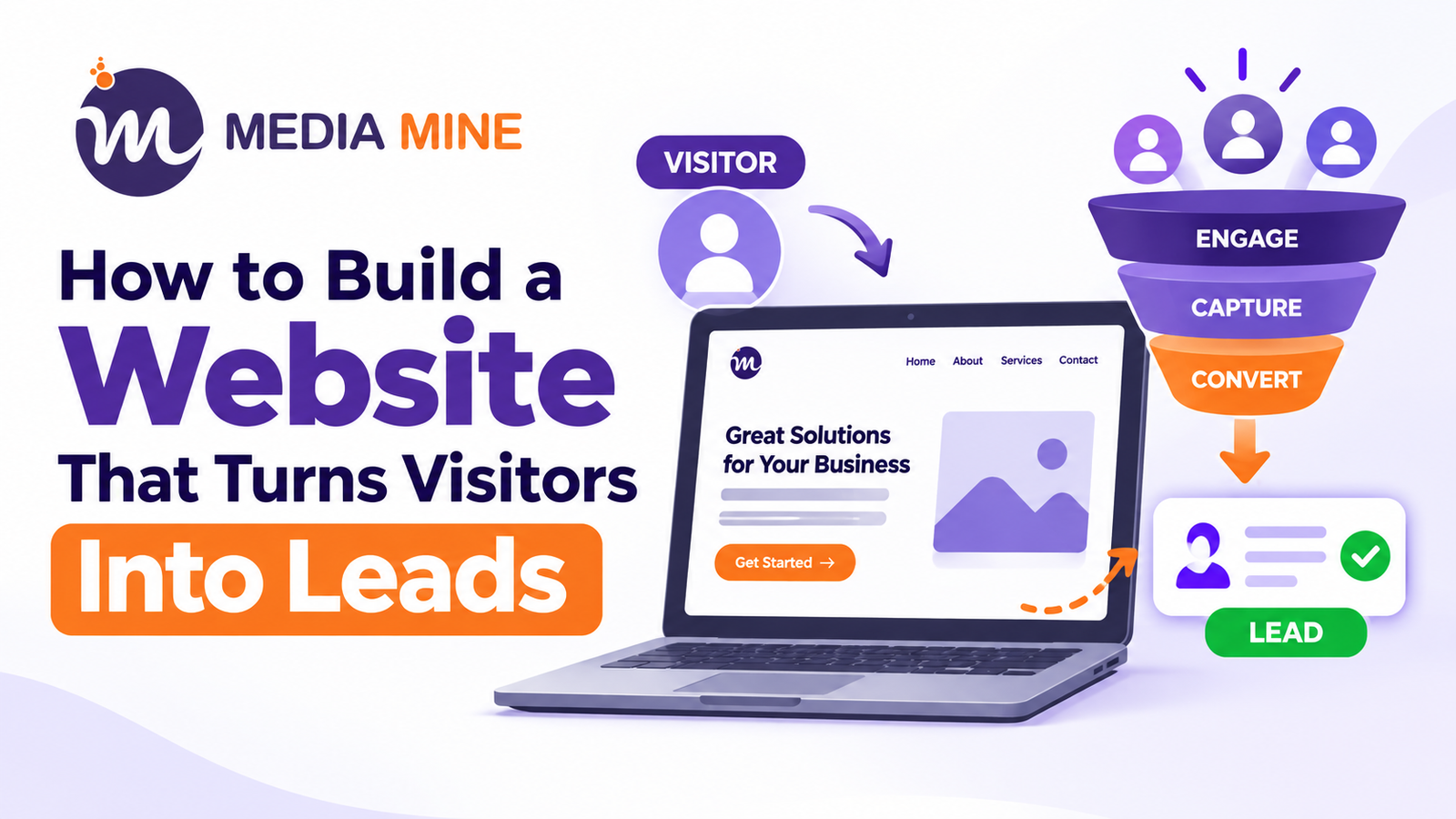
Your website is often the first conversation a potential customer has with your brand. In 2026, when buyers compare options in seconds and expect everything to work instantly on their phones, a site that merely looks good isn’t enough. You need a high-converting website that guides visitors toward action and turns traffic into qualified leads. A professional website is one of the most reliable drivers of business growth.
Whether you’re planning business website development from scratch or rebuilding an underperforming site, here is a practical framework for creating a lead generation website that earns its place in your sales funnel.
1. Start With a Clear Goal and Audience
Before any design work begins, answer two questions:
- What is the one main action you want visitors to take? (Book a call, request a quote, download a guide, start a trial.)
- Who exactly are you speaking to? (Their role, problems, objections, and what they search for.)
A site built for “everyone” converts no one. Clear goals shape your structure, messaging, and CTA placement, and they give you a baseline for measuring your website conversion rate later.
2. Invest in Strategic Website Design
Good website design is not decoration. It directs attention. A few principles that consistently help:
- Clear visual hierarchy: The headline, supporting text, and primary button should be obvious within three seconds.
- Consistent branding: Colors, fonts, and imagery should build trust, not confusion.
- White space: Breathing room makes content easier to scan and key actions easier to spot.
- Real proof: Testimonials, client logos, case studies, and certifications reduce hesitation.
Design that looks impressive but hides the next step will lose to a simpler page that makes the next step obvious.
3. Prioritize User Experience (UX)
User experience is where conversions are won or lost. Visitors leave when they can’t find what they need quickly. If you’re new to the topic, our guide on what UI/UX design is is a good starting point. To improve UX:
- Keep navigation simple, with a few clear menu items.
- Use descriptive headings so people can scan.
- Write short paragraphs and use plain language.
- Make contact details and forms easy to find.
- Remove friction: every extra form field or unnecessary click costs you leads.
Think of UX as removing obstacles between your visitor’s problem and your solution.
4. Build a Truly Mobile-Friendly Website
Most web traffic now comes from phones, so a mobile-friendly website is the baseline, not a bonus. Go beyond “it shrinks to fit”:
- Use tap-friendly buttons with enough spacing.
- Keep forms short and use the right input types (phone, email).
- Make sure text is readable without zooming.
- Place click-to-call and WhatsApp buttons where thumbs reach easily.
- Test on real devices, not just browser emulators.
If the mobile experience is clumsy, you’re quietly losing the majority of your potential leads.
5. Optimize Website Speed
Website speed affects both user patience and search visibility. Slow pages raise bounce rates and lower conversions. To keep your site fast:
- Compress and properly size images, and use modern formats like WebP or AVIF.
- Minimize heavy scripts, plugins, and third-party widgets.
- Use reliable hosting and a content delivery network (CDN).
- Enable caching and lazy loading.
- Regularly audit performance with tools like Google PageSpeed Insights and Core Web Vitals reports.
Speed is invisible when it’s good and very visible when it’s bad.
6. Write CTAs That Actually Get Clicked
A CTA (call to action) is the bridge between interest and inquiry. Strong CTAs are:
- Specific: “Get Your Free Website Audit” beats “Submit.”
- Benefit-driven: Tell people what they get, not just what to do.
- Visible: Use contrast and placement above the fold, mid-page, and at the end.
- Consistent: Don’t offer five different actions on one page; keep one primary CTA and one secondary at most.
Test button copy, color, and position. Small changes can noticeably shift results over time.
7. Use Dedicated Landing Pages
General pages try to do many things; landing pages do one. For campaigns, ads, and specific services, create focused pages with:
- A headline that matches the ad or search intent
- A concise value proposition
- Social proof near the form
- One CTA and minimal navigation distractions
- A short, friction-light form
Dedicated landing pages typically convert better than sending paid or organic traffic to a busy homepage, and they make A/B testing much easier.
8. Build an SEO-Friendly Website From Day One
Leads need visitors first. An SEO-friendly website is built with search engines and users in mind:
- Logical site structure and clean URLs
- Unique title tags and meta descriptions for every page
- Proper heading hierarchy (H1, H2, H3)
- Fast load times and mobile responsiveness
- Helpful, original content that answers real search questions
- Internal links connecting related pages
- Schema markup where relevant
Retrofitting SEO later is more expensive than planning it into the build. Good technical foundations and good content work together. For more ideas, see these proven strategies to improve your Google rankings.
9. Consider Custom Website Development for Long-Term Growth
Templates are fine for quick launches, but they can limit performance, flexibility, and branding. Custom website development lets you:
- Build around your exact customer journey
- Integrate CRMs, analytics, booking tools, and automation
- Control performance by avoiding bloated code
- Scale features as your business grows
- Stand out visually instead of looking like everyone else
If lead generation is a core business goal, a tailor-made site is usually a smarter long-term investment than a generic one. Working with professional website development services also ensures strategy, design, development, and SEO are aligned instead of handled in silos.
10. Track, Test, and Keep Improving
A website is never “done.” To improve your website conversion rate:
- Set up analytics and conversion tracking (form submissions, calls, clicks).
- Use heatmaps and session recordings to see where users struggle.
- A/B test headlines, CTAs, forms, and layouts.
- Review performance monthly and fix the biggest drop-off points first. A regular website audit helps catch costly mistakes early.
- Keep content fresh and update outdated pages.
Data replaces guesswork, and steady optimization compounds over time.
Quick Checklist for a High-Converting Lead Generation Website
- One clear goal and defined audience
- Clean, trust-building website design
- Simple, friction-free user experience
- Fully mobile-friendly layout
- Fast loading pages
- Prominent, benefit-driven CTAs
- Focused landing pages for campaigns
- SEO-friendly structure and content
- Analytics and ongoing testing
Final Thoughts
A high-converting business website isn’t the result of one trick. It’s the combination of smart strategy, thoughtful design, strong UX, speed, SEO, and continuous improvement. When these elements work together, your website stops being a digital brochure and becomes a dependable lead generation engine.
Need a Website That Does More Than Just Look Good?
If you want a site built to attract the right visitors and turn them into customers, the team at Media Mine can help with strategy, design, development, and optimization.