
Introduction
If your website isn’t showing up on the first page of Google, you’re losing out on traffic, leads, and revenue every single day. SEO (Search Engine Optimization) isn’t a one-time task it’s an ongoing process that, when done right, builds long-term visibility and trust for your brand.
In this article, we’ll walk through 10 proven SEO strategies that consistently move the needle on Google rankings. We’ll also share a real case study showing exactly how these strategies helped improve rankings for one of our clients with results you can see for yourself.
1. Do Proper Keyword Research
Everything in SEO starts with knowing what your audience is actually searching for. Guessing keywords is one of the fastest ways to waste time and budget.
Use tools like Google Keyword Planner, Ahrefs, SEMrush, or Ubersuggest to find keywords with solid search volume and manageable competition. Don’t just chase high-volume terms long-tail keywords (longer, more specific phrases) often convert better because they match clearer search intent. Someone searching “SEO agency” is browsing; someone searching “affordable SEO agency for small e-commerce stores” is closer to buying.
Before targeting any keyword, ask: what is the person actually trying to find? Matching search intent (informational, navigational, or transactional) is often more important than the keyword itself.
2. Optimize Your On-Page SEO
On-page SEO tells Google exactly what each page is about.
- Title tags & meta descriptions: Keep titles under 60 characters and make them compelling, not just keyword-stuffed. Meta descriptions won’t directly boost rankings, but a good one improves click-through rate.
- Header tags (H1, H2, H3): Use one clear H1 per page, and structure content logically with H2s and H3s. This helps both readers and search engines understand your content.
- Clean URL structure: Short, readable URLs (e.g.,
/seo-strategiesinstead of/page?id=4521) perform better and look more trustworthy. - Natural keyword placement: Work keywords into your title, first paragraph, and a few headers naturally. Keyword stuffing can actually hurt you.
3. Create High-Quality Content
Google’s algorithms are built to reward content that genuinely helps people. Thin, generic content doesn’t rank no matter how well “optimized” it is.
Focus on originality and real value. Cover topics in enough depth to actually answer the searcher’s question, but don’t pad content just to hit a word count. Improve readability with short paragraphs, bullet points, and subheadings most people skim before they read.
4. Improve Your Website Speed
Page speed is both a ranking factor and a user experience issue. A slow site frustrates visitors and increases bounce rate, which signals to Google that your page isn’t serving users well.
Ways to speed things up:
- Compress and properly size images
- Use browser caching and a good hosting provider
- Minimize unnecessary scripts and plugins
Test your site regularly with tools like Google PageSpeed Insights or GTmetrix, and act on their recommendations.
5. Make Sure Your Site Is Mobile-Friendly
Google uses mobile-first indexing, meaning it primarily looks at the mobile version of your site to determine rankings even for desktop searches.
Your site needs a responsive design that adapts cleanly to any screen size, with tap-friendly buttons, readable font sizes, and no horizontal scrolling. If your site isn’t mobile-optimized in 2026, you’re already behind.
6. Build a Smart Internal Linking Structure
Internal links help users navigate your site and help Google understand which pages matter most.
Link relevant pages to each other using descriptive anchor text (not “click here”). This distributes “link juice” across your site and helps search engines discover and index new or underlinked pages faster.
7. Build Quality Backlinks
Backlinks remain one of Google’s strongest trust signals, but quality beats quantity every time. Ten backlinks from relevant, authoritative sites will outperform a hundred spammy ones.
Effective approaches include:
- Guest posting on reputable sites in your niche
- Outreach to journalists and bloggers (digital PR)
- Broken link building: finding dead links on other sites and offering your content as a replacement
8. Handle the Technical SEO Basics
Technical SEO ensures Google can actually crawl and index your site properly.
- Submit an XML sitemap through Google Search Console
- Configure your robots.txt file correctly so you’re not accidentally blocking important pages
- Make sure your site runs on HTTPS
- Regularly check Search Console for crawl errors and fix them promptly
9. Focus on User Experience (UX)
Google increasingly rewards sites that keep users engaged. A high bounce rate or low time-on-page can hurt your rankings indirectly by signaling poor content match or bad experience.
Improve UX with:
- Clear, intuitive navigation
- Strong, visible calls-to-action (CTAs)
- Good Core Web Vitals scores (loading, interactivity, visual stability)
10. Monitor Performance and Adjust Continuously
SEO isn’t “set it and forget it.” Use Google Analytics and Google Search Console regularly to track keyword rankings, organic traffic, and user behavior. When something isn’t working, adjust your strategy. SEO rewards consistency and iteration, not one-off effort.
Real Case Study: How These Strategies Improved Rankings for Our Client
To show these strategies aren’t just theory, here’s a real example from our own work.
The Client: Awais International is a Lahore-based computer and laptop store, serving as an authorized channel partner for major brands like HP, Dell, Lenovo, and Canon. With a strong wholesale network of 150+ resellers across Pakistan and 15 years in the IT business, the company had a solid offline reputation, but their online visibility didn’t reflect that.
Despite selling in a highly competitive space (laptops, desktops, printers, and IT accessories), their website was barely showing up for the product and category searches that mattered most.
Starting Point: Before optimization, most of Awais International’s target keyword things, like laptop price searches and specific product-category terms, were ranking on page 3 or beyond.
The site had slow-loading product pages, weak internal linking between product categories and blog content, and several technical issues flagged in Search Console, including missing meta descriptions and unsubmitted sitemap updates. Organic traffic was minimal, with most visibility coming from direct and referral sources rather than search.
What We Did:
We applied a combination of the strategies covered above, tailored to a competitive IT/electronics niche:
- Keyword research: Identified high-intent keywords across product categories (laptops, desktops, printers, monitors) along with long-tail variations buyers actually search for.
- On-page SEO overhaul: Rebuilt titles, meta descriptions, and header structure across key product and category pages.
- Technical fixes: Resolved crawl errors, fixed broken links, and properly submitted the XML sitemap through Search Console.
- Speed optimization: Compressed product images and cleaned up unnecessary scripts to improve load times.
- Internal linking: Connected product pages with relevant blog content (like buying guides) to strengthen site structure and keep users engaged longer.
- Content and backlinks: Supported the blog section with relevant, search-friendly content and began targeted outreach for quality backlinks.
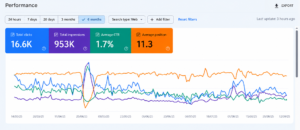
The Results: Within a few months, Awais International saw a clear upward shift in organic impressions and clicks in Search Console. Several product and category keywords moved from page 3+ into the top 10, and organic traffic began contributing meaningfully to overall site visits for the first time reducing reliance on direct and paid channels alone.
Key Takeaway: This case study reinforces a core SEO truth: no single tactic works in isolation. It was the combination of technical fixes, on-page optimization, content, and consistent monitoring that moved the needle for Awais International. For a business competing in a crowded IT retail space, that structured, multi-pronged approach made the difference between page 3 obscurity and real search visibility.
Conclusion
Improving your Google rankings isn’t about chasing one trick — it’s about consistently applying fundamentals: solid keyword research, quality content, technical health, speed, mobile-friendliness, and a good user experience. As the case study above shows, real results come from combining these strategies and sticking with them over time.
Start with an audit of where your site currently stands, pick two or three strategies from this list to focus on first, and build from there. If you’re not tracking your progress in Google Search Console and Analytics yet, that’s the very first step to take today.