Ever posted something on your business page, checked back an hour later, and seen… nothing? Two likes, one from your cousin. Meanwhile, a competitor with a worse product somehow shows up first on Google. Sound familiar? You’re not doing anything wrong exactly—you just don’t have a strategy yet. And that’s fixable.
This guide is a practical walkthrough for building a real digital marketing strategy for 2026. Not a theory, not a list of buzzwords—an actual framework you can sit down and use this afternoon. Whether you’re starting completely from scratch or trying to fix a plan that’s fizzled out, you’ll walk away knowing how to pick the right channels, set a budget that makes sense, and put together a small business marketing plan that actually fits how big (or small) your team is.
What Is a Digital Marketing Strategy, Really?
Strip away the jargon and it’s this: a digital marketing strategy connects your business goals to the specific things you do online to hit them. There’s a big difference between “We should post more” and “We’re using Instagram to bring in 20% of new customer inquiries by Q3.” One is a vibe. The other is a plan.
If you’re new to all this, digital marketing for beginners basically comes down to three questions:
- Who are you actually trying to reach?
- Where do they hang out online?
- What do you want them to do once they find you?
SEO, social posts, email, ads — all of that is just the how. The strategy is the why and what. Skip that part and you’ll end up doing a little bit of everything and a lot of nothing, which honestly is where most small businesses get stuck.
Why 2026 Is a Bit Different
Search results now lean on AI-generated summaries more than ever, social platforms have basically stopped rewarding polished, ad-like content in favor of stuff that looks real, and people expect brands to actually respond when they message. An online marketing strategy for startups that was cutting-edge in 2020 just doesn’t hit the same anymore. That’s not meant to scare you — it just means the old playbook needs an update.
How to Create a Digital Marketing Strategy for Small Businesses in 2026
Here’s the step-by-step digital marketing plan for beginners we actually use with our own clients—no filler.
Step 1: Pick One Goal
Not five. One. More site visitors, more phone calls, more sales — whichever metric matters most to your business right now, that’s your north star for the quarter.
Step 2: Actually Know Your Audience
Can you describe your ideal customer’s biggest frustration in a single sentence? If not, that’s your homework before anything else. Vague messaging never converts — it just blends into the noise.
Step 3: Audit What You Already Have
Before building anything new, look at what’s already there. Your website, your social profiles, your Google listing — most small businesses have more assets sitting around unused than they realize.
Step 4: Choose Two or Three Channels, Not Ten
This is honestly where a lot of good digital marketing tips for small business advice gets ignored. Trying to be everywhere at once spreads you thin, and nothing gets done well. Pick fewer channels and actually show up on them.
Step 5: Map Out a 90-Day Content Calendar
Ninety days is a sweet spot—long enough to notice what’s working, short enough that you’re not locked into a bad plan for a year.
Step 6: Set Up Basic Tracking
Google Analytics plus whatever native insights your platforms offer is plenty to start. Don’t overthink the tools part.
A Real Example
We worked with a small local bakery that had zero strategy — just posting “when we remembered.” We helped them pick one goal (more weekend foot traffic), narrow down to two channels (Instagram and local SEO), and run a focused 90-day sprint. Saturday orders picked up noticeably, and they didn’t spend a cent more on ads to get there.
How to Create a Marketing Strategy That Actually Includes SEO
Search visibility isn’t a “nice to have” anymore—it’s basically the ground floor everything else is built on.
SEO Strategy for Small Business: The Basics
A solid SEO strategy for small businesses doesn’t require a computer science degree. It comes down to a handful of things:
- Local SEO — claim your Google Business Profile and actually fill it out
- On-page basics — clear page titles, decent meta descriptions, sensible headers
- Content that answers real questions — blog posts built around what people are typing into Google
- Backlinks—local directories, partnerships, guest posts, that kind of thing
A Quick Reality Check
SEO isn’t instant. It’s a compounding thing, more like planting a tree than flipping a switch. Most small businesses start seeing real traffic somewhere between month three and month six. Which is exactly why it should start on day one—not get bolted on later once you’ve run out of other ideas.
Social Media Marketing Strategy for 2026
A working social media marketing strategy starts with matching the platform to your audience — not to whichever app you personally enjoy scrolling.
- Instagram & Pinterest — great for visual products, lifestyle brands, local services
- LinkedIn — where B2B and professional services actually get traction
- YouTube, Reels, Shorts—short-form video is still eating everyone’s attention in 2026
As an example, our team shares client results and behind-the-scenes agency stuff over on Instagram and Pinterest, while our LinkedIn leans more into industry commentary. Same brand, three different tones — because the audiences are different too.
Building a Content Marketing Plan That Doesn’t Fall Apart
A good content marketing plan feeds both your SEO and your social presence at once, instead of treating them as separate jobs. A simple hub-and-spoke approach works well:
- One comprehensive guide (like this one) that targets your core topic
- Smaller blog posts, checklists, and comparisons that all link back to it
- Social posts that repurpose pieces from both
It’s a lot more sustainable than scrambling for a new topic every single week, and it compounds—each piece makes the others slightly stronger over time.
Digital Marketing Budget for Small Business: What’s Actually Realistic?
This is probably the question we get asked most: “Okay, but how much should I actually be spending?”
A reasonable starting range for a digital marketing budget for small businesses is somewhere around 5–10% of gross revenue, adjusted depending on how fast you want to grow. If that still sounds like a lot, start smaller and reinvest as things start working—this is where affordable digital marketing for small businesses really comes into play. You don’t need a huge budget to get moving. You need consistency and the right priorities, in that order.
Where the First Dollars Should Go
- A website that’s fast, mobile-friendly, and has a clear call to action
- Local SEO setup
- One paid channel test (Google or Meta Ads) with a modest, controlled spend
- Content — whether that’s in-house or outsourced
Best Marketing Channels for Small Business: A Side-by-Side Look
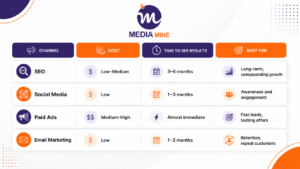
There isn’t really one “best” answer here the best marketing channels for small businesses depend entirely on your goals, your timeline, and your budget. Most strategies that actually work end up blending two or three channels rather than betting everything on one.
Your Small Business Digital Marketing Checklist
Before launching anything new, run through this:
- One clear, measurable goal defined
- Target audience described in a single sentence
- Website checked for mobile speed and clarity
- Google Business Profile claimed and filled out
- Two to three channels chosen — not more
- 90-day content calendar drafted
- Basic tracking setup
- Budget set as a percentage, not a guess
Bookmark this, screenshot it, or whatever works; it’s meant to be revisited every quarter as things shift.
Frequently Asked Questions
What is the best digital marketing strategy for a small business in 2026?
Honestly, there isn’t one single “best.” The strategies that work well tend to combine local SEO, one or two social platforms picked deliberately, and content built around what customers are actually asking.
How much should a small business spend on digital marketing?
A common starting point is 5–10% of gross revenue, scaling up once a campaign is clearly paying for itself.
Can I do digital marketing myself, or do I need an agency?
A lot of businesses start out doing it themselves and bring in outside help once SEO, content, or ads need to move faster than their team can manage alone.
How long does SEO actually take to work?
Most businesses start seeing real movement around the three-to-six-month mark, and it keeps building from there.
What’s the biggest mistake small businesses make with digital marketing?
Trying to be active everywhere at once instead of picking one or two channels and actually doing them well.
Ready to Build Your 2026 Strategy?
None of this works unless it actually gets executed consistently, and in the right order. If you’d rather skip the trial and error part, our team at Media Mine 360 builds strategies like this for small businesses every day, from SEO to social to full website builds.
Reach out to our team and let’s talk through your goals, or take a look at our services to see where we could help you grow in 2026.